
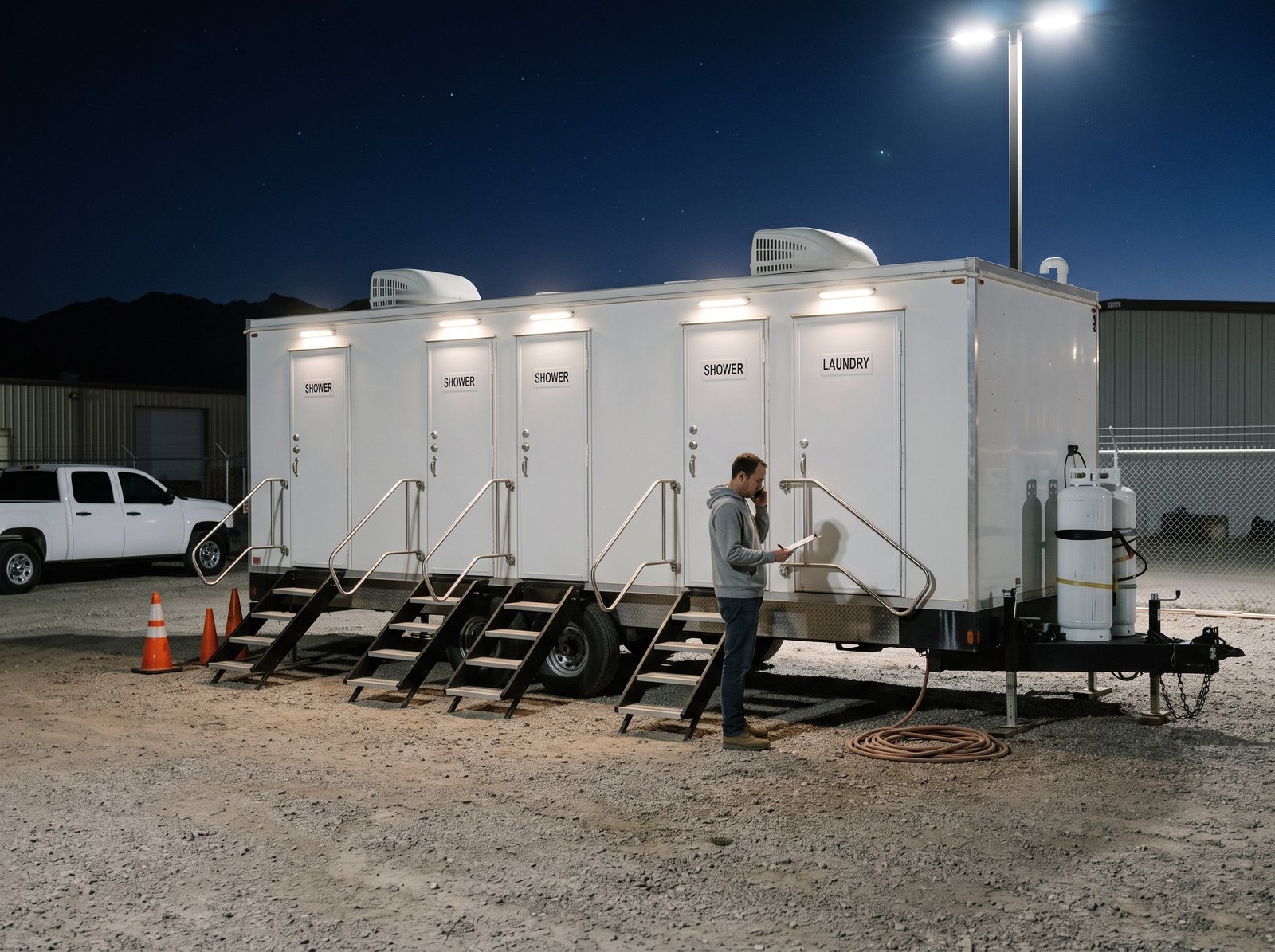
The line
One number, answered by somebody who loads trailers
The number rings straight to us. Whoever picks it up has leveled one of these on a bad pad, chased a gate code at six in the morning, and pumped a tank with dust blowing sideways, so nothing you describe is going to be unfamiliar and nobody is going to read you a script.
That has a practical consequence worth knowing about: the person on the phone can decide things. Whether a unit is free for your window, whether a road is realistic for the trailer you need, whether the interval you are imagining will hold with your headcount. You get the answer while you are still on the call rather than a promise to check with someone.
The rhythm of who calls is fairly predictable. Saturday mornings are mostly event people working out logistics for something a few weeks out. Sunday evenings are frequently a superintendent who has realized the crew starting Monday has nowhere to wash off before the drive home. Both are entirely normal here. If we are under a trailer when you ring, leave the town, the dates and a rough headcount, and you get a call back from a person rather than a reference number in an email.
Dial (702) 960-1918. Someone who runs these trailers picks up, any day of the week.
On the phone with us
What callers say about reaching dispatch
★★★★★I called at six in the morning expecting a voicemail. The person who answered could tell me right then whether a unit was free for our shoot dates.
★★★★★Our clubhouse lost hot water for a week. One phone call, some questions about the parking lot, and a trailer was set the next afternoon.
★★★★★When I explained it was a shelter, they moved us up the schedule and called me back twice to confirm the staging spot.
The first call
Seven things a booking call works through
Nobody needs to prepare for this. You talk, we take notes, and the shape of the job usually lands before either of us has said anything technical. Underneath the conversation, though, we are working through the same seven things every time, and knowing them means you can answer in one pass instead of three.
What you are running. A paving stretch, a rodeo weekend, a camp going in on raw ground, a production unit parked somewhere with a good horizon and nothing else. The category tells us more than any single detail, because a construction placement and an event placement behave in opposite directions: one is a long steady rhythm, the other is a short violent spike.
How many people, and when they all arrive. Not the badge count. The number who will genuinely use it, and whether they trickle through across a shift change or pile in together when a whistle blows or a gate closes. The busiest twenty minutes of the day is what decides the unit. A hundred people spread across two shifts is an easier job than sixty who all finish at once.
Where it sits. The actual spot, not the address. What the ground is, how level it sits now, and what happens to that ground when it rains hard. If you are somewhere without a street address, a highway mile marker plus the color of your gate works fine. Our drivers find sites off US 95 that way regularly.
How a truck and trailer get in and back out. Gate width and hours, surface on the way in, turning room at the end, and anything overhead. Overhead is the one that catches people, because wires, branches, canopies and low entries get noticed by exactly nobody until a driver is looking up at one.
Water and power. Is there a hose bib within reach, is there a circuit we can use, or is it neither. If the answer is neither, that is an ordinary Tuesday for us and we say so on the call rather than leaving you wondering whether you have just described an impossible job.
Dates, and whether they can move. Start, end, and how firm both are. A window with a day of flex in it can often be filled faster than a fixed date, and you should know that before you decide the date is fixed.
Whether a service truck can reach it. Separate question from delivery access, and the one that gets missed most. A trailer tucked perfectly into a tight dock area can be impossible to pump without moving it, and that is far better discovered on the phone than on day four.
Then comes the part you actually rang about: whether we have a unit free for your window, what we would put on the ground for a job that shape, and what the service rhythm behind it looks like. You hear all three out loud while you are still on the phone.
Before you dial
Four answers that turn a call into a booking
You can ring with none of this and we will work it out together. But if you happen to have these four in front of you, a first call frequently ends with a unit held rather than with a list of things to go and find out.
- The real headcount
- How many people will actually shower on site, and whether that number changes across the life of the job. Crews ramp. Event staff arrive days before the public does. Both move the service schedule.
- A photograph of the spot
- One picture of where you want the trailer, taken standing where the truck would come in. It answers surface, slope, overhead and turning room in a single message and it is the most useful thing anybody sends us.
- Who is on site and when
- A name and a number for whoever will be there at delivery to point at the pad, plus the hours the gate is genuinely open rather than the hours it is supposed to be.
- What the site has
- Water, power, sewer, some of them, or nothing. Nothing is fine. Wrong information is not, because it is what decides whether a generator and a hauling schedule leave the yard with the trailer.
No address
Describing a site that a mapping app cannot find
A good share of the ground we deliver to has no street address, and this is the part of the call where people apologize unnecessarily. Drivers find these sites regularly. What they need is not an address, it is a sequence.
Start with the highway and the direction of travel, then the turn off with something physical attached to it: a mile marker, a cattle guard, a windmill, a sign, the second dirt road past a particular junction. Then the distance in from the highway, in miles rather than minutes, because minutes depend on what you are driving. Then what the gate looks like and whether it is locked, and who has the combination or the key. Then what the last stretch is: graded gravel, washboard, sand, a low water crossing, a climb.
Two extra details save more time than anything else. First, whether the road narrows anywhere, because a pickup fits through gaps that a truck with a trailer behind it does not. Second, whether there is anywhere to turn around at the end, since the alternative is reversing a long way out of somewhere nobody should have entered.
Coordinates are welcome if you have them and they are genuinely of the pad rather than of the general area. A pin dropped on a satellite view of the right corner of the right parcel is worth more than a paragraph. So is a photograph taken standing at the turn off looking in, which answers half of the questions above without anyone having to describe anything.
If you are not the person who has driven it, tell us who is and we will ring them. A two minute call with the foreman who runs that road every morning beats a careful guess from an office every single time.
Urgent work
Same week, tonight, and the calls that jump the queue
Some calls cannot wait for a scheduling conversation, and they get handled differently. An evacuation shelter standing up this evening. A fire camp going in tomorrow. A building that lost hot water with people still living in it. A flood cleanup where crews are already working and nobody has anywhere to get clean before they eat and sleep.
For those, ring and keep talking. A written request is too slow to be kind. What we need in the first sixty seconds is the staging point, roughly how many people, and whether anything is running out there already: water, power, or nothing at all. Everything else can be sorted while a driver is hooking up.
These get inserted into the schedule and something else moves. Whoever gets moved hears about it from us with a reason, rather than finding out when a truck does not appear. That only works because the board is kept honest the rest of the time, and it is the main reason we do not promise a date we are not sure of.
Same week work that is not an emergency sits in the middle. Inside the valley it is often straightforward, because a truck is likely heading that direction anyway and placements here are short hauls. Further out it depends on what is already committed in that direction, since deliveries, service visits and pickups get grouped by road rather than by the order the calls came in. The honest answer to how fast is always specific to the week you are asking about, which is why it is a phone call rather than a number on a page.
One thing worth saying about timing in the south: convention weeks and big race weekends move everything. Traffic, rooms and equipment availability all tighten inside the same few days. If your job lands on one of those weeks, the earlier the call the better the answer will be.
Events
Calls about a date already printed on a poster
Event calls have a different shape because the date cannot move and everything else has to bend around it. The first question is usually availability, and the second should be lead time, because the windows that matter get committed a long way ahead and being on the board early decides which unit you get rather than whether you get one.
The second thing event organizers usually need from us is not equipment at all, it is facts in writing. If your event is in Clark County, the Southern Nevada Health District special event process asks the organizer how the event handles drinking water, wastewater disposal and handwashing. Those are questions about our unit, and we can put the answers in writing so you are not guessing on an application. The permit itself is yours to obtain and deadlines apply. Clark County's list of special event permit types is the place to start in the south, and the requirements change again up north and in the rural counties that work through the state. Confirm with whoever covers your ground rather than assuming one rule covers everywhere.
The third thing is servicing, and it is where event jobs are won or lost. Usage is concentrated rather than spread, so a multi day run needs the tanks handled during the event and not after it, inside whatever quiet window your schedule allows. Overnight, between sessions, before gates open. Getting a service truck through a festival ground mid afternoon is not an experiment anybody enjoys twice, so it goes on the plan at booking.
Tell us the whole schedule on the call, including the load in and load out days. Production and vendor staff are frequently on the ground for days before the public arrives and after they leave, and on a lot of events those people are who the showers are genuinely for.
Long jobs
Work that runs for months rather than days
Bring the whole schedule to the call, not just the day it starts. A long placement is a service rhythm more than it is a delivery, and the rhythm gets built from your shift pattern, your headcount curve and the drive between us and you.
Things we will ask about on a long job that would not come up on a weekend rental: whether the crew size ramps, and roughly when. Whether there is a phase where the site gains utilities that it does not have now. Whether the unit will need to move as the work progresses, which is normal on corridor work and on sites that go vertical where the trailer used to sit. And whether the job runs through a season change, because a unit that goes out in September into the northern corridor needs cold weather setup before the first hard night rather than after it.
Extending is routine. Almost every long job we do runs longer than the original booking, and a schedule that moves is not a problem as long as we hear about it before the pickup is already on the board. The same goes for shortening it: if the work finishes early, say so and we will come get the unit rather than leaving it sitting on your job cost.
After the call
What happens between hanging up and the trailer arriving
The call produces three things: a unit, a window and a service plan. If any of the three cannot be settled honestly on that call, you get a straight answer about which one and why rather than a booking that quietly falls apart later.
Once it is confirmed, the delivery goes on the board in the direction it belongs, since runs are grouped by road. You get a real date. Paperwork goes wherever it needs to, which for a general contractor usually means a safety or procurement contact who wants the certificates before the gate opens rather than after somebody stops the driver.
Ahead of delivery day, the driver has the site details in hand: gate, contact, where the unit is meant to sit, what is available at that spot. If anything has changed between booking and delivery, and on a construction site something usually has, a call from you saves the driver an hour and saves you a rescheduled delivery.
On the day, the driver places the unit, levels it, makes the connections, and runs every stall before leaving: hot water, drains, lights, latches, vents, steps. Then there is a short walkthrough with whoever is on site covering how it works, where the shut offs are, when the service visits fall and the number to call in between. That last part is the reason most mid rental calls take about ninety seconds.
Mid rental
If one of our trailers is on your site right now
Same number, same people. A question about a unit already on the ground goes to whoever set it, which means you are not explaining your site from scratch to somebody reading it off a screen.
Faults first: water running cool, a drain slowing down, a door catching, a heater cycling oddly, a generator that sounds wrong. Ring and describe what you are looking at. We would far rather hear about it the morning it starts than at the end of the rental when it has been annoying people for two weeks and quietly convinced a crew the whole thing was not worth it.
Then the ordinary changes, none of which are a process. Keep it another two weeks. Add a second unit because the crew grew. Move it across the site as the work shifts. Tighten the service interval because your numbers jumped in week three and the tank is filling faster than the plan assumed. Book the pickup so it does not land in the middle of your demobilization. Every one of those is a phone call and a scheduling decision.
The one we most want to hear about early is headcount. A tank that was sized for forty people behaves very differently with seventy using it, and the difference between a tightened schedule and an unpleasant Friday afternoon is usually a call somebody nearly made on Wednesday.
Rather type
When you would rather write than call
Plenty of people would rather do this at eleven at night with the schedule open in front of them and nobody on the other end of a line. That is what the quote page is for. It asks for the same things we would ask on the phone, in the same order, and it explains itself when you get there.
Written requests suit some jobs better than a call does. If you are assembling a bid and need the same information three vendors have given you, in writing, to attach to a proposal, a form is the right tool and a phone conversation is not. The same goes for anything that has to go through a procurement system, where a written record of what was asked and what was answered matters more than speed.
A written request reaches the same people, and it gets answered by one of them rather than by an automatic reply. What a form cannot do is the back and forth: the moment where you describe the spot, we ask one follow up question, and the answer changes which trailer we would send. If your job has anything unusual in it, the phone is still faster.
Still working out what you need? What we rent walks through the inside of the trailers and what they draw and hold. Where we deliver covers the cities, the towns and how a long run across the state actually goes. And if you would rather think it through before speaking to anybody, the field notes take the same ground slower than a call can.
Asked on nearly every call
Shower trailer questions people ask us first
These are the ones that surface in the first few minutes, with the same answers we would give you on the phone.
Does somebody have to be on site when the driver arrives?
Ideally yes, for five minutes. Somebody who can point at the pad, confirm the spot still works and take the walkthrough. Where that is genuinely impossible we can work from photographs and a phone call, but a delivery with nobody there is the one most likely to end up with the trailer in the wrong place.
Who is responsible for getting the pad ready?
The site. We will tell you exactly what the surface needs to be and flag anything in a photograph that looks like it will cause trouble, but grading, compacting or clearing a spot happens before delivery day rather than by our driver on arrival.
Can you deliver outside normal hours?
Frequently, and on resort and event work it is often the only option. Dock windows, overnight load ins and early starts before a gate gets busy are all normal. Tell us the window on the call and the run gets built around it.
Can you send paperwork to our safety office?
Yes, and before the trailer arrives rather than after somebody at a gate asks. Give us the contact on the booking call and certificates and vendor forms go straight there.
Do you handle the event permit?
No, that belongs to the organizer, and requirements differ by county. What we can do is put in writing what the unit provides on water source, wastewater containment and handwashing, which is usually the part of the application that is actually about us.
What if our dates slip after we book?
Call. Dates move on almost every construction job and a fair number of events, and a schedule that shifts is a scheduling problem rather than a crisis as long as we hear about it before a truck is already loaded for you.
What if the weather turns on delivery day?
We look at it the day before, not the morning of. A summer storm in the south or a snow event in the north can change a departure time or a placement decision, and you will hear from us about it rather than watching a truck arrive into something nobody should be working in.
When to ring
Call early, late, on weekends and holidays
Before six in the morning is a good time to reach us, because that is when drivers are hooking up and everybody is standing in the yard anyway. Late evening works too. The hour nobody gets through is the middle of a delivery, and that is what the call back is for.
Holidays are the same number. Work does not stop in this state for a date on a calendar, and the weekends either side of a big convention or race week are some of the busiest calls we take all year.
There is a seasonal pattern to it as well, and it is worth knowing if your job has any flexibility in it. The phone runs hardest in the south through spring and again once the worst of the summer heat breaks, and hardest in the north through the building season before the cold sets in. Midwinter in the southern valley and the shoulder weeks either side of the big event dates are the quietest stretches we have, and a job that lands in one of those is a job with more choice of unit behind it.
If you leave a message, three things make the call back useful: the town, the window of dates, and a rough count of people. With those in a voicemail we can look at the board before we ring you, and the conversation starts at the answer instead of at the beginning.
By the clock
Delivery times from the Las Vegas yard, town by town
How fast a call becomes a truck on the road depends on two things: whether a unit is free for your window, and how far the job is from our yard in the valley. The first changes week to week. The second does not, so here it is.
| Where the job is | Drive from our yard with a trailer | When a unit is free, delivery usually lands | Service visits |
|---|---|---|---|
| Las Vegas, Henderson, North Las Vegas | Under an hour | Same day or next day | Short loop, seen on short notice |
| Boulder City, Jean, Sloan, Indian Springs | About an hour | Next day is common | Fits a normal service route |
| Pahrump, Overton, Searchlight | About an hour to an hour and a half | A day or two of notice | Water and waste handled in one visit |
| Beatty, Pioche | Two to three hours or more | Planned a few days out | Fixed interval built around the drive |
| Reno, Sparks, Carson City, Minden | A full driving day | Planned delivery with a set departure time | Fixed interval, water and waste together |
After hours works the same way. The number rings through at night, on weekends and on holidays, and a fault on a unit already on your site goes to whoever set it. A unit that is completely out of service, with no hot water or a tank that will not drain, goes ahead of routine calls. Inside the valley that can mean the same night if a truck can reach it safely. A slow drain or a sticky latch gets fixed on the next scheduled visit unless you would rather we came sooner.
If you leave a message after hours, say whether the unit is down or just acting up, and give the town. Those two details decide whether the callback comes right away or first thing in the morning, and whether a driver is already heading your direction.
Straight answers
When the answer on the call is no
Not every call ends with a booking, and the useful thing is hearing why in the first conversation rather than the fourth.
Sometimes the unit you want is already committed for your window. You get the real date it comes free, and if that does not work, you get told plainly so you can go and find someone else while there is still time to. A hopeful date that slips is worse than a no, because a no can be planned around.
Sometimes the site cannot take the trailer you are picturing. A road that will not accept the combination, a spot with no turning room at the end of it, overhead that cannot be cleared, or ground that would need real work before anything heavy sat on it. That conversation happens on the phone, with photographs if needed. It usually ends with a smaller unit or a different spot. Sometimes it ends with a plain list of what the site has to fix first, usually gravel over soft ground or a low branch trimmed back at the gate.
And sometimes the schedule cannot be serviced. A site several hours out with a headcount that would need attention every other day is a placement that looks fine on delivery and falls apart in week two. In that case the answer is bigger capacity, more frequent visits at a realistic interval, or a straight admission that the arrangement will not hold.
None of those are pleasant answers to give. All of them are cheaper than finding out later, and they are the reason the dates we do commit to are worth something.
No obligation
Calls about pricing a bid or comparing options
A good share of our calls are not going to turn into a rental this month and that is fine. You are pricing a bid you have not won. You are comparing what two outfits would put on the same pad. You are trying to work out whether the site you have in mind can even take a trailer this size before you commit to it in a proposal.
Ask the questions, hang up, and come back when the work is real. Nobody chases you in between and nobody adds you to something. The reason we take those calls seriously is straightforward: a bid that gets priced accurately is a job that runs properly if it is won, and the alternative is a surprise for everybody in month two.
The same applies to the question people are slightly embarrassed to ask, which is whether they need one of these at all. Sometimes the honest answer is no. If the crew is fifteen minutes from a gym or a yard with real showers they can use, you do not need us, and we will say so. You will get that answer if it is the true one.