
The yard
Everything starts on our own ground
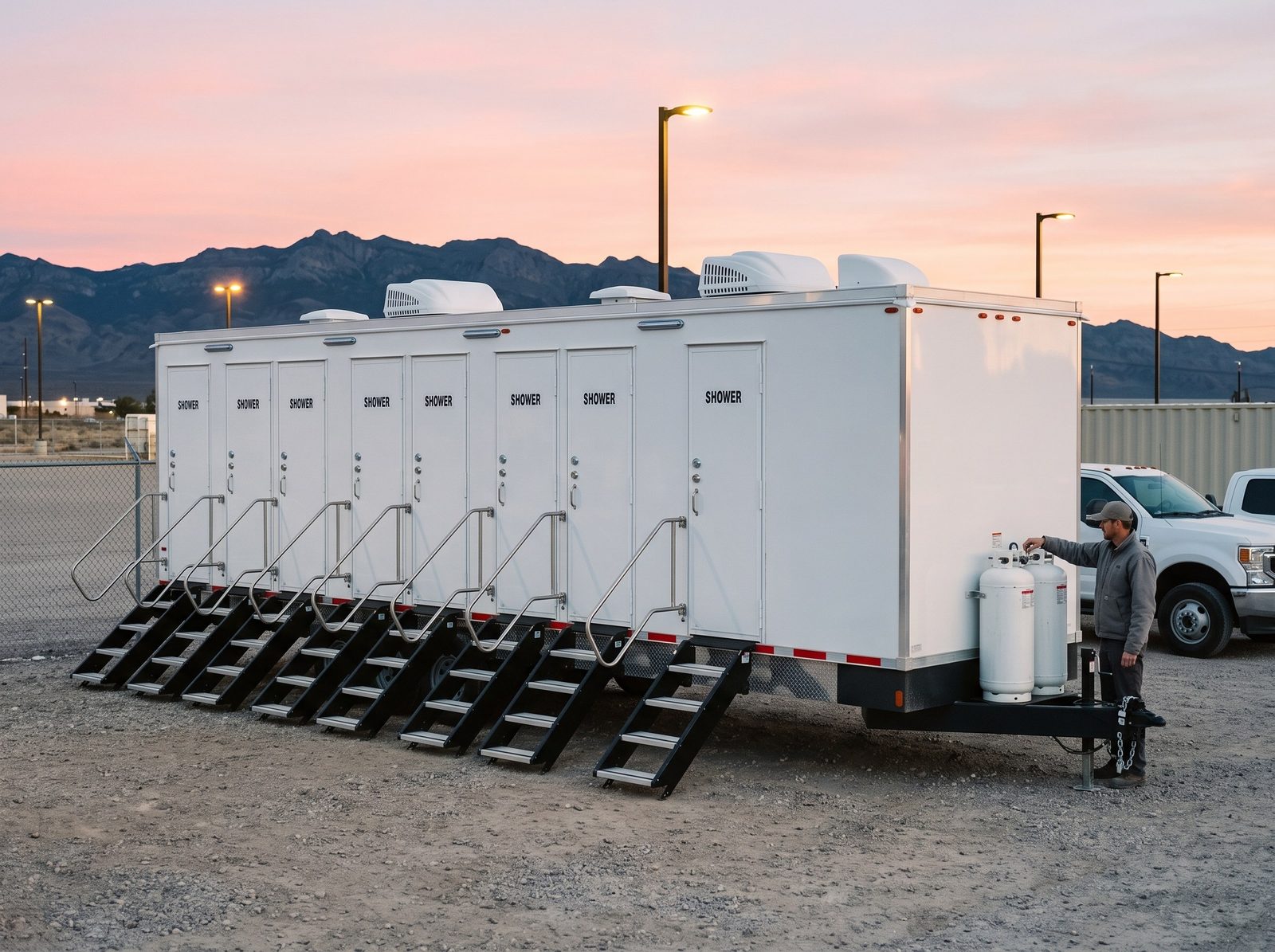
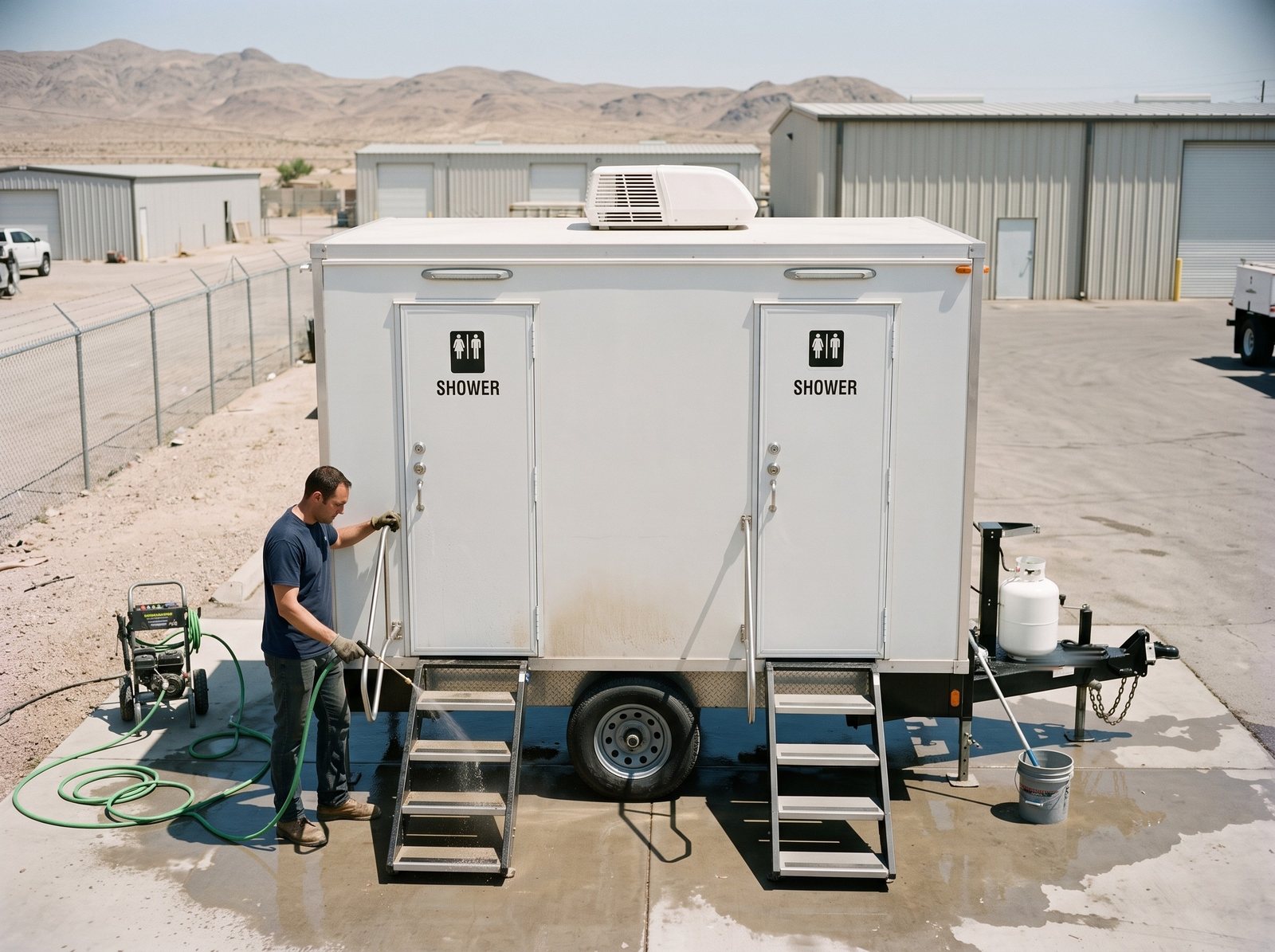
Before a trailer goes anywhere it sits in the yard and gets worked over. Tanks flushed and filled. Water heater fired and run until it holds temperature under flow rather than just lighting. Every door opened, closed and locked, every drain run, every light, vent and vanity switched on. Floors and walls washed down instead of wiped around. Then the dull half: tires, bearings, brakes, lights and the hitch, because plenty of our runs are long and a breakdown on the shoulder of a two lane highway helps absolutely nobody.
Doing all of that here rather than at your site is the entire point of having a yard. A unit already sorted only needs level blocks, water from a hose bib or its own full tank, and power. So the visit is short and quiet instead of an afternoon of chasing faults in the sun with your crew standing around waiting to find out whether they are getting a shower.
The yard is also where a unit lands between jobs, which is when the honest inspection happens. A trailer coming off a dusty desert placement gets its condenser fins and intake vents cleaned properly, not blown at. And a trailer coming off a winter placement in the north gets its heat tape, tank pads and skirting checked before it goes back out, because those are exactly the components nobody notices have failed until the night they were needed.
What customers tell us
The people who called us, in their own words
★★★★★The same guy who took my call was the one who backed it in. He already knew our gate closes at three and planned the delivery around it.
★★★★★Back of house jobs are all badges and dock windows. Their driver was on our gate list before he arrived and never once held up the loading dock.
★★★★★I asked for insurance certificates on a Thursday and had them Friday morning. That alone put them ahead of the last two vendors we used.
The standard
Clean enough that the crew actually walks in
The fastest way to waste money on a shower trailer is to put one on a site nobody wants to use. Crews work out a bad unit inside two days. Then they drive home dirty. And the line item stays on the job cost with nothing to show for it. So the bar is plain and we do not move it: a private stall with a door that latches, a dry place to change behind that door, hot water that stays hot when several stalls run at once, and air conditioning or heat depending on the month.
Cleanliness on a live job is a schedule, not a promise. The service visit includes the interior properly cleaned, consumables restocked and the drains run, and on dusty placements the vents and filters as well. Between visits the unit belongs to the crew using it. Most sites handle that fine. But a unit taking far heavier use than the booking anticipated is a call we would rather get early than find on the next visit.
We would also rather hear about a fault the morning it starts than at the end of the rental. A heater acting up, a drain running slow, a latch that has started sticking: call and somebody comes out. The equipment side of all of this is laid out on what we rent.
Dispatch
How a job gets on the board
A job becomes real when three things are settled: which unit, which window, and what the ground under it is. Until those exist it is a conversation, not a booking, and we say so rather than holding a date we know will move.
Once it is on the board it joins a schedule that is mostly geography. Deliveries, service visits and pickups get grouped by direction, because a truck already heading out of the valley on a particular highway may as well carry the second job on that road. That is why the answer to how soon we can be somewhere is sometimes tomorrow and sometimes the day after next week: it depends on what is already committed in that direction, and we would rather give you the real date than an optimistic one you build a shift around.
Emergencies break the pattern, and they should. A camp going up tonight, an evacuation shelter, a building that lost hot water with people still in it. Those get inserted and something else moves, and whoever was moved gets a phone call explaining why rather than discovering it when nobody shows up. That works because we keep the board honest in the first place. An outfit that has already promised every unit twice has nothing left to move when something real happens.
Long hauls get planned as routes rather than destinations: departure time, fuel, where a truck and trailer can actually turn around, whether the gate is open when the driver arrives, and whether anyone will be on site to point at the pad. Leaving the valley we are weighing one highway against another, and that choice sometimes changes the hour the driver pulls out. The map and the regional detail behind all that is on where we deliver.
The set
What the driver does between arriving and leaving
The driver arrives with the site details already in hand, which is the product of the questions we asked on the phone. Gate, contact, where the unit is meant to sit, what is available at that spot. The first thing that happens is a look at the pad in person, because a spot that was described as flat sometimes is not, and it is far cheaper to have that conversation before the trailer comes off the hitch.
Then placement and leveling. The unit goes where the site wants it if that spot works, and somewhere better if it does not, with an explanation rather than a decision made quietly. Leveling blocks and jacks handle minor grade. Orientation gets chosen deliberately: door side away from the afternoon sun in the south, doors and steps on the sheltered side where wind is a factor, and clear of anywhere water will run if the sky opens.
Connections follow. Water in, whether that is a bib or a full tank. Power, whether that is a site circuit or the generator positioned where its noise bothers the fewest people. Waste connected to an approved point or the onboard tank confirmed and the pump out access checked, which is a different question from delivery access and gets asked on the spot.
Then every stall gets run before the driver leaves. Hot water at the head, drains flowing, lights, latches, vents, steps and handrails. If something is wrong it gets fixed there with tools already on the truck, or the unit goes back and a different one comes out, which is a bad afternoon for us and a far better one for you than finding out at six the next morning.
The last five minutes are the walkthrough with whoever is on site: how the unit works, where the shut offs are, what the service schedule looks like, and the number to call if something changes. That conversation is the reason most of our mid rental calls are short.
Servicing
The visits after the first one
A rental is mostly the visits after delivery, and the interval between them is built from the job rather than from a template. Headcount and shift pattern set how fast the tanks move. Drive time sets how flexible the schedule can be. A unit inside the valley sits on a tight loop and can be seen on short notice. A unit several hours out gets fresh water and waste handled in the same visit on a fixed interval, because sending a truck that far twice for two halves of one job makes no sense to anybody.
On a live event the visit has to fit inside your quiet window, which means the service run gets planned around the event schedule rather than ours. Overnight, between sessions, before gates, whatever the run actually allows. Getting a service truck in and out of a festival ground mid afternoon is not something anybody wants to attempt twice.
The visit itself is the same list every time: waste pumped, fresh water refilled, interior cleaned, consumables restocked, drains run, fixtures checked. In the dusty months the vents and condenser get attention. Through a northern winter the freeze protection gets checked rather than assumed, because heat tape and a tank pad are exactly the kind of thing that fails silently.
What changes the interval mid job is almost always headcount. A crew that ramps up through a build phase, or an event whose vendor and production numbers climb for days before the public arrives, will move a tank faster than the original plan assumed. Tell us and we tighten the schedule. That call costs a minute. The alternative costs a morning.
The people
The same hands that load a trailer answer the phone
This is a small operation on purpose. The person who takes your call has leveled one of these on a bad pad, chased a gate code at six in the morning and pumped a tank in a dust storm, which means nothing you describe on the phone is going to be new information and nobody is going to read you a script written by somebody who has never seen a job site.
That matters most in the middle of a conversation about something unusual. A site with a fall across it, a gate that only opens for an escort, a crew that triples for one week, a road that a mapping application swears is paved. Those all get a real answer in the moment because the person answering has the authority and the experience to give one, rather than a promise to check and call back that turns into two days of silence.
Drivers carry the same latitude on site. A driver who arrives to find the intended spot unusable is expected to say so and propose a better one, not to set the unit where it was pointed and let somebody else deal with it later. A driver who finds a fault during the stall test is expected to fix it or pull the unit, not to note it for the next visit. But that only works if the people doing it know the equipment properly. It is the main argument for keeping the crew small and keeping the work in house.
Who we work for
What each kind of customer needs from a vendor
The equipment barely changes between jobs. What changes is what the customer needs from us around it, and getting that wrong is how a rental goes badly with a perfectly good trailer on the ground.
- Large construction and industrial builds
- Data center and distribution work on newly graded land runs for months with crews that swell and shrink through phases. What they need is a service interval that flexes with headcount, paperwork that satisfies a general contractor's safety office before the gate opens, and a vendor who can be reached by a superintendent rather than a portal.
- Mining and exploration camps
- Remote, waterless, running on multi week hitches. They need the self contained setup handled without drama. The delivery has to land the day the camp goes in, not a week after, and pump outs get scheduled around the road into camp rather than around our convenience.
- Highway and utility crews
- Linear work that moves down a corridor in phases, often at night. They need a unit that can be repositioned on a few days of notice and a servicing plan that assumes the location will not be the same one in a month.
- Resort and facility back of house
- Work inside an occupied, operating property. They need a tight footprint, a presentable unit, delivery inside a dock window, and a driver who already knows the rules before he is standing at the guard shack asking about them.
- Events and production
- Compressed schedules and concentrated usage. They need servicing that fits inside quiet windows, honest answers about what the unit provides for a health district application, and enough lead time that the dates are actually held.
- Response and emergency operations
- Fire camps, evacuation shelters, flood cleanup. They need speed first and paperwork second, a straight answer on the phone about what can reach them and when, and a vendor who will hold the placement as long as the operation lasts rather than pulling it for a better booking.
What repeats
The same four site problems, over and over
After enough deliveries, the failure modes stop being varied. Four things account for most of the bad days, and all four are decided before the trailer leaves.
The first is the pad. Somebody describes a spot as level and it has a fall across it, or it is soft where it looked firm, or it sits in the low corner of a lot that becomes a pond in a summer storm. Photographs solve this in about ninety seconds and we would rather ask for them than talk around it.
The second is access, and specifically the overhead half of access. Width and surface get thought about. Wires, branches, canopies and low entries do not, until a driver is looking up at one with a trailer behind him and nowhere to reverse to.
The third is headcount, counted too low. Nobody means to. The number of people who will genuinely shower on site is frequently higher than the number somebody assumed when the job was quoted, and a tank that was going to last four days lasts two and a half. The fix is a tighter interval, and the cost of the fix is a phone call if we hear about it early.
The fourth is weather taken from the wrong forecast. A southern generator sized on a mild day, or a northern unit set out in October with no freeze protection because it was still warm at noon. Both are avoidable and both are expensive. And the second one can end a rental outright.
Sizing honestly
We will tell you when the job needs less than you asked for
People call with a number already in their head and it is often bigger than the work calls for. If showers spread across a shift change, roughly one stall for every eight to ten people keeps a line from forming. If everybody hits it at once, after a whistle or after a race, you need more doors than that. Tell us the shape of the day and we size to the day rather than to the headcount on paper.
Sometimes the honest answer is a smaller unit and a staggered schedule, and we will say that even though the bigger unit would have been an easier sale. Sometimes the spot you were picturing will not take the trailer you were picturing, and the conversation has to be about where it can genuinely sit before anything else is decided. Occasionally it runs the other way and the job needs more than you planned, usually because the number of people who will actually shower turns out to be higher than the number somebody assumed.
The reason we push on this is that a right sized unit is the one that keeps getting rented. An oversized trailer looks generous on the first invoice and then sits three quarters empty while somebody on your side quietly decides the whole arrangement was a waste. An undersized one produces a line at the worst moment of the day and a crew that gives up on it by the end of the week. Neither outcome brings the call back next season, and a rental business that depends on repeat work from a state this size cannot afford either one.
If accessibility matters on your site, raise it on the first call. Accessible layouts get committed further ahead than standard ones and availability on specific dates is a real limit, so the early answer is worth more than a hopeful one.
Weather as a discipline
Two climates, one fleet, and a forecast we actually read
Working in this state means running the same equipment through two genuinely different climates, and the mistake is planning either one off a statewide forecast.
In the south, summer is the obvious constraint. A trailer with its rooftop units baking through a long afternoon works considerably harder than the same trailer with a little shade, so where we set it matters nearly as much as which unit we sent. Then there is the quieter southern problem: fine dust, and the storm season in late summer that pushes walls of it ahead of sudden, violent rain. A desert placement through those weeks asks for attention that a paved lot never does, and the pad has to be chosen for where the water goes as well as for how flat it is, because a low spot that was dry that morning can be running water twenty minutes into a storm.
Go north and it inverts. Nights up there drop below freezing well past the point the calendar suggests spring has arrived, and a forgotten water line is what ends a rental early and at real cost. We set the freeze protection on the forecast rather than the date, and we check it on every visit through the cold months. Wind is the other northern factor, particularly through the gap between the ranges, where a stall door left open facing the wrong way is a bent door by morning.
Then there is the calendar that only matters here. Convention weeks and big race weekends move the whole valley at once: traffic, rooms and what equipment is already committed. If your job lands on one of those weeks, the earlier you talk to us the better the answer will be.
Working on someone else's ground
Site rules, paperwork and the people who enforce them
A good share of our work happens inside somebody else's controlled environment, and the rules there are not obstacles, they are the job. Back of house work at an operating property means dock windows, badging, an escort to the pad, noise limits because guests and staff are on the other side of a wall, and an expectation that the unit looks presentable rather than industrial. A secured industrial site means a gate list submitted ahead of time and a driver who is actually on it. A government or utility site adds its own layer on top of that.
We are licensed and insured, and the paperwork can go to your safety or procurement contact before the trailer arrives rather than after somebody at a gate asks for it. Certificates, vendor forms and whatever your system needs are a normal part of the setup and not something we treat as an imposition.
On the regulatory side, the useful thing to understand is that there is no single rule covering temporary facilities statewide. Construction work falls under the federal construction sanitation standard, 29 CFR 1926.51, which sets toilet counts against crew size, requires real handwashing with soap and running water rather than sanitizer alone, and treats a facility that takes more than roughly ten minutes to reach as not available at all. Public events are a different track. In Clark County the Southern Nevada Health District runs the health side of special event permits, and its application asks how the event handles drinking water, wastewater and handwashing. Rural counties outside those districts work differently again.
The permit is the organizer's to obtain. What we can do is put in writing exactly what the unit provides on all three of those points, which is usually what the application is actually asking for, and tell you honestly when a question belongs to the health authority rather than to us.
The vendor packet
The insurance certificate and forms your job office wants
General contractors, resort properties and public agencies all want vendor paperwork cleared before the truck reaches the gate. The requests repeat enough that we keep the packet ready. Here is what usually goes out, in roughly the order people ask for it.
- Certificate of insurance
- The certificate lists the coverage your contract calls for. If your company needs to be named as additional insured, send the insurance section of the contract with the booking. The request goes to our carrier with your exact wording, so the certificate comes back matching the contract instead of needing a second pass.
- W-9 and vendor setup
- Your accounts payable forms, filled in and returned with the certificate, so the first invoice does not stall in a new vendor queue.
- Gate list and driver details
- Driver names plus a description of the truck and trailer, sent ahead for secured sites and government ground. If the site badges vendors, tell us how far ahead the list closes.
- Site orientation
- Some sites want a safety orientation before anyone works past the gate. Tell us how long it runs and the delivery time gets set so the orientation does not eat the dock window. Our drivers arrive in a hard hat, a high visibility vest and boots. Say so if your site asks for more.
- Unit facts in writing
- One page covering stall count, the accessible layout if there is one, water source, wastewater containment, handwashing and power draw. It goes into the permit application for an event and into the compliance file for a job site.
- Service record
- On long placements, a dated list of service visits is available to your safety office on request, which answers the question an inspector usually asks first.
- Invoices
- Billed against your PO number and job name, with the placement dates on each one, so it matches your job cost without anybody rebuilding it.
The fastest version of all of this is simple: give us the safety or procurement contact on the first call. The packet goes to them directly and is usually cleared long before the delivery date gets close.
Our limits
Three things we will not do
Most of what goes wrong on a rental was decided before the trailer moved. These are the shortcuts that cause it, and we do not take them.
- Promise a date we are not sure of
- If the unit you want is already committed, you get the real date instead of a hopeful one. A delivery you can build a shift around is worth more than an optimistic one that slips and takes your schedule with it.
- Drop a trailer and go quiet
- The rental covers delivery, leveling, the water and waste side and every visit after. Somebody from here stays attached to the job until we come back for the unit, and the number you called to book it is the same number that answers mid rental.
- Guess at access
- We ask about gate width and hours, surface, grade, overhead lines, turning room and where power and water sit. If we still cannot picture it, we ask for photos. Guessing is how a truck ends up backing a mile out of a site it should never have entered.
There is a fourth, less dramatic one: we do not promise more than the unit does. If your job needs four doors we will say four, and if it needs more than you budgeted for we will say that too, before you commit rather than after. The long version of the site side is in how to choose and prepare a shower trailer site in Nevada.
What we keep
The site notes that make the second job faster
Every placement leaves a record behind it, and it is the plain kind: which gate actually worked, who opens it, what the surface was, where the driver had to swing wide, whether the overhead was tight at the entrance, what the real service interval turned out to be once the crew got going, and where the pump truck could reach. None of that is interesting on its own. All of it saves an hour the next time somebody calls from the same site.
That matters more than it sounds in this state, because the same ground comes back. An industrial park builds in phases over years. A fairground runs the same event every autumn. A property works on one tower and then the next. A highway corridor works its way along in sections. When the second call comes, the conversation can start at scheduling instead of starting over at what the road is like.
It also means we can be honest about a site we already know. If a spot gave us trouble last time, you will hear that on the phone rather than watching us find it again. If the interval we used last year was too generous for how the crew actually behaved, we will propose a tighter one and say why.
The other half of the record is what a job taught us generally. A road that has degraded, a gate policy that changed, a stretch of highway with construction that adds an hour to a northern run. Those get carried across jobs, which is the practical value of running a small operation where the same handful of people see everything.
The whole arc
The whole arc of a rental, in order
Strung together, a rental runs in a fixed sequence, and knowing the order is most of what makes it feel simple from your side.
It opens with a conversation about the work, the people and the ground. That conversation produces a unit, a window and a service plan, and if any of the three cannot be settled honestly, it produces a straight answer instead of a booking. Once it is confirmed, the delivery goes on the board in the direction it belongs, and you get a real date rather than a range.
Delivery day is placement, leveling, connections, a full test of every stall and a walkthrough with whoever is on site. From there the rental is a rhythm: service visits on the agreed interval, adjusted when your headcount or schedule moves, with the same people on the other end of the phone the entire time.
Changes mid rental are normal and none of them are a process. Keep it another two weeks, add a second unit as the crew grows, move it across the site as the work shifts, or bring the pickup forward because the job finished early. Each of those is a phone call and a scheduling decision, not a form.
At the end we collect the unit and leave the pad as we found it. If the job is likely to come back, say so, because the next one is easier when the site details are already on file and nobody has to establish the same facts twice.
Licensed and insured, with the paperwork available to your safety or procurement contact before the trailer arrives.