
Multi stall
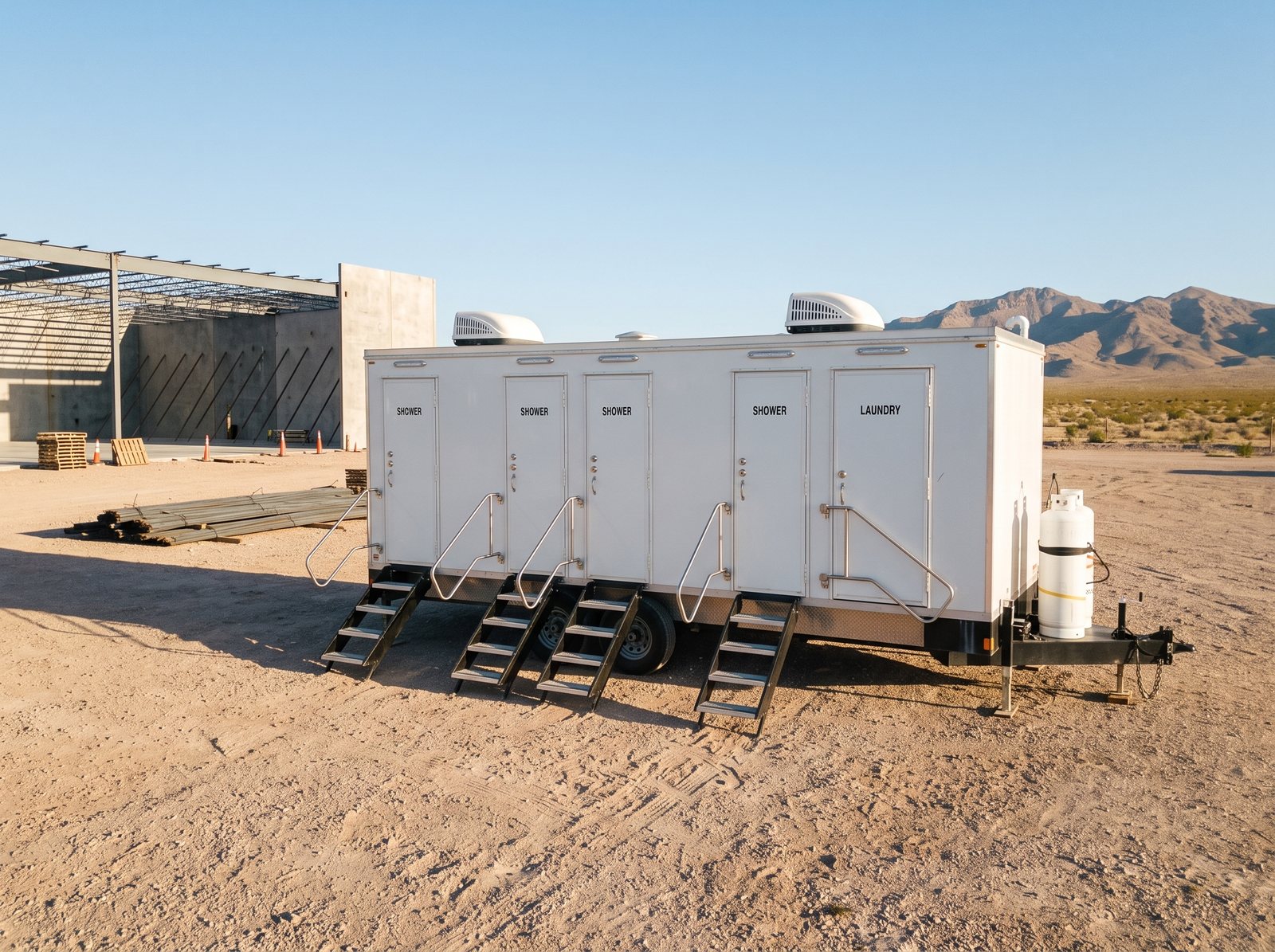
Four stall shower trailer
Four private doors with fold down steps. A common pick for mid size crews and smaller events around the valley.
The equipment
Locking stalls, water heated as people use it, climate control both directions, and onboard capacity for ground with no services
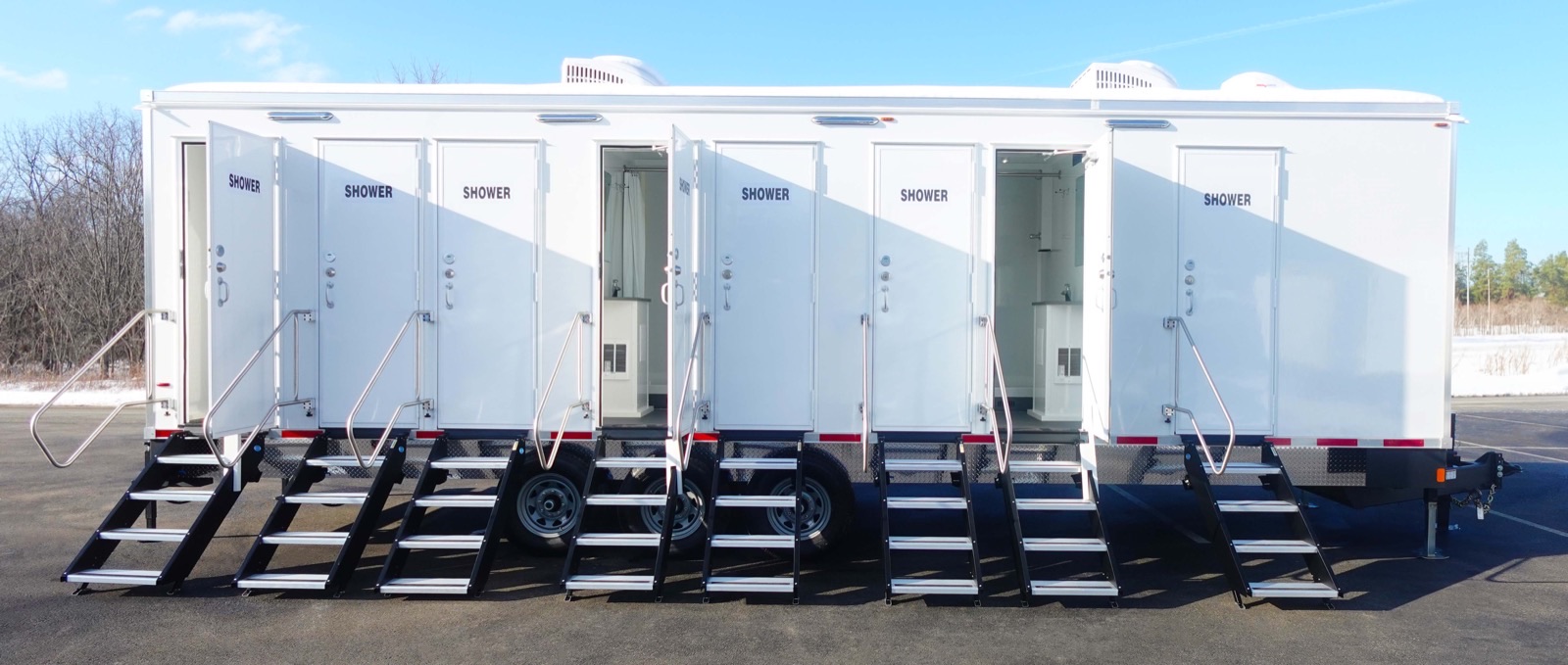
Every unit we rent is a towable trailer with individual shower rooms, hot water heated on demand, heating and air conditioning, a finished interior and its own fresh and waste tanks. And that last part is what lets one of these work on a graded pad with no utilities for miles.
This page is the long version: what is inside, what it draws, what it holds, how long it runs between service visits, and how to work out which size a job actually needs. If you already know the shape of the work, call (702) 960-1918 and skip ahead.
The lineup
Everything else follows from how many doors you need. A four stall unit covers a crew of thirty or so when showers spread across a shift change, which suits a typical back of house renovation along the Strip. An eight stall trailer keeps a full shift change moving without a line forming in the dirt. Combo units add laundry or restroom rooms when a camp needs more than a rinse, which is normal on multi day events and long rotations.
The units differ in more than door count. A bigger trailer carries more fresh water and more waste capacity, which changes how often somebody has to come back, and it draws more power, which changes the generator. Those two consequences are usually what decides the answer once we know the headcount, not the stall number by itself.
Multi stall
Four private doors with fold down steps. A common pick for mid size crews and smaller events around the valley.
High headcount
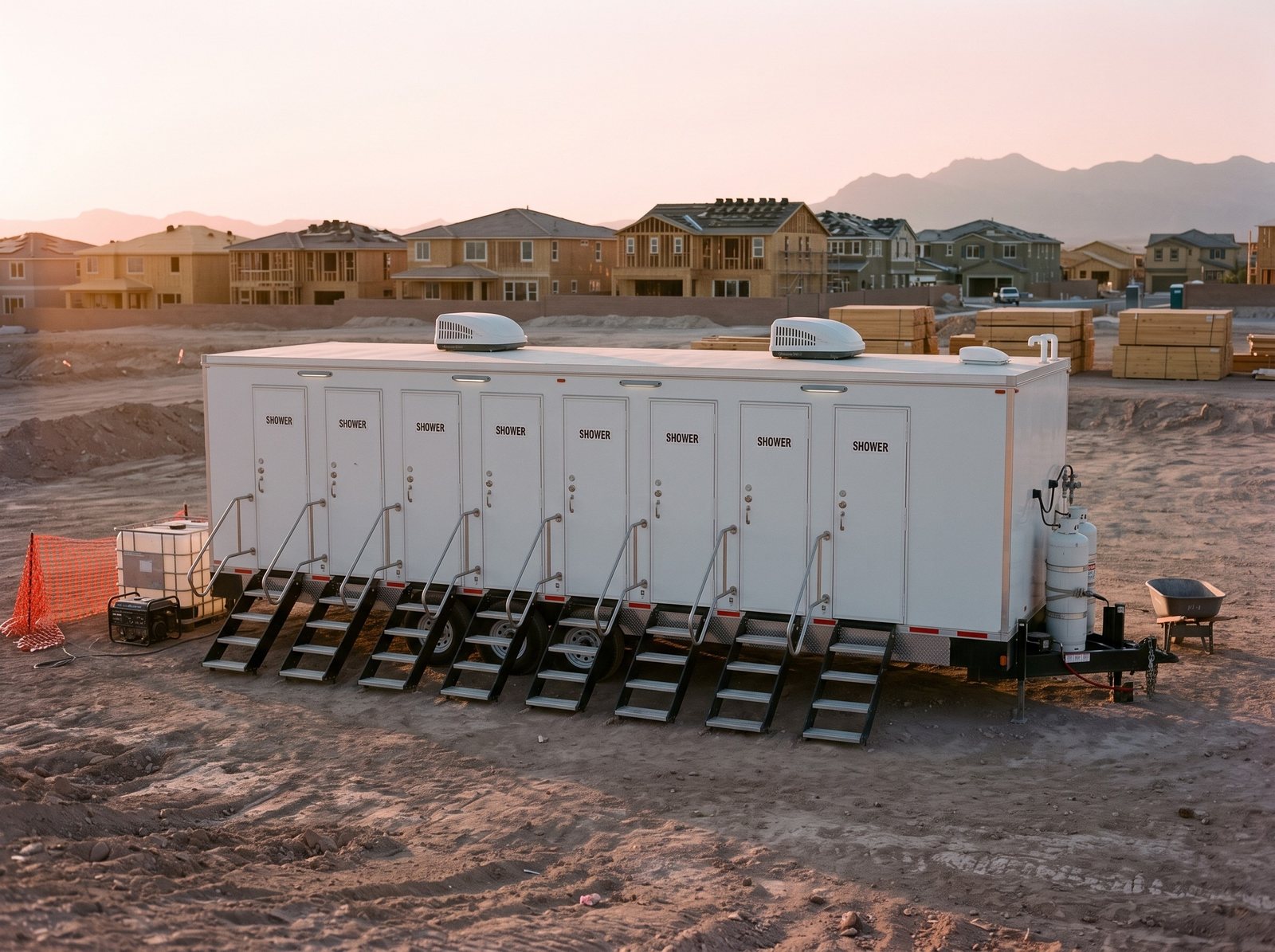
More doors for larger crews and festival staff. Roof air conditioning for open pads in July.
Combo
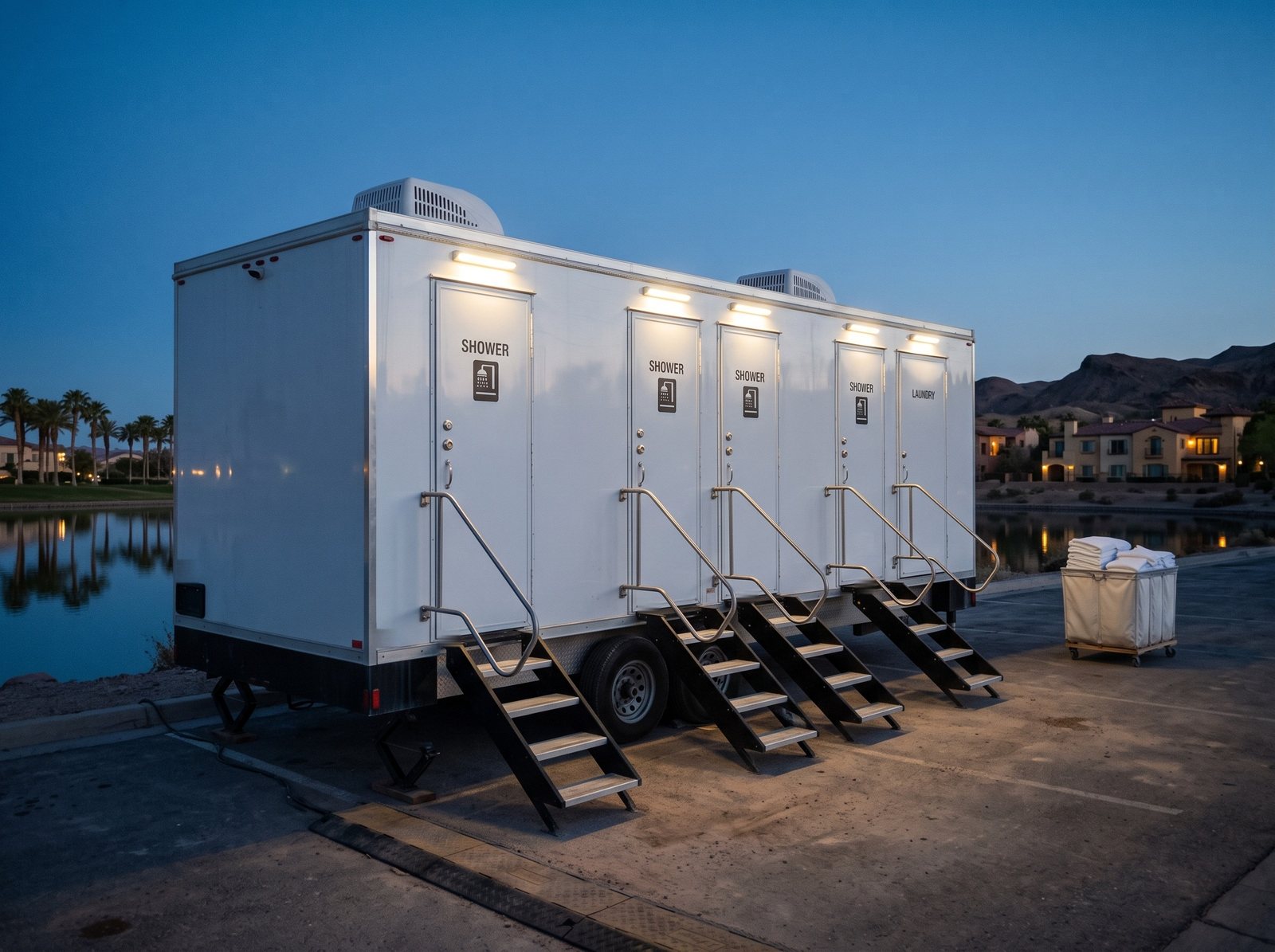
When a base camp needs more than a rinse. Useful on multi day events and long term housing.
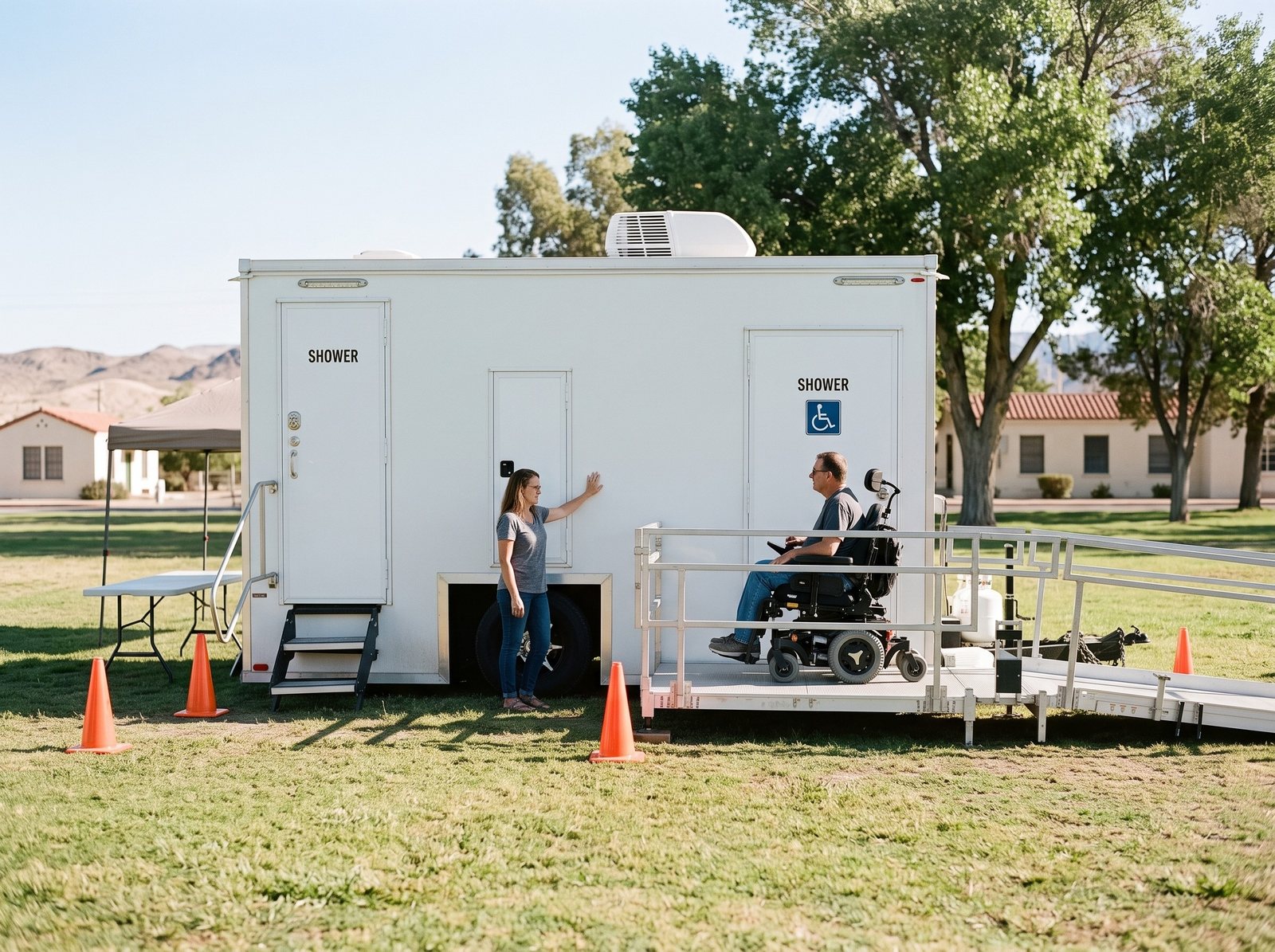
Accessible
Pictured on the park lawn in Boulder City.
Ask early. Accessible layouts get committed sooner than standard stalls, especially around convention weeks.
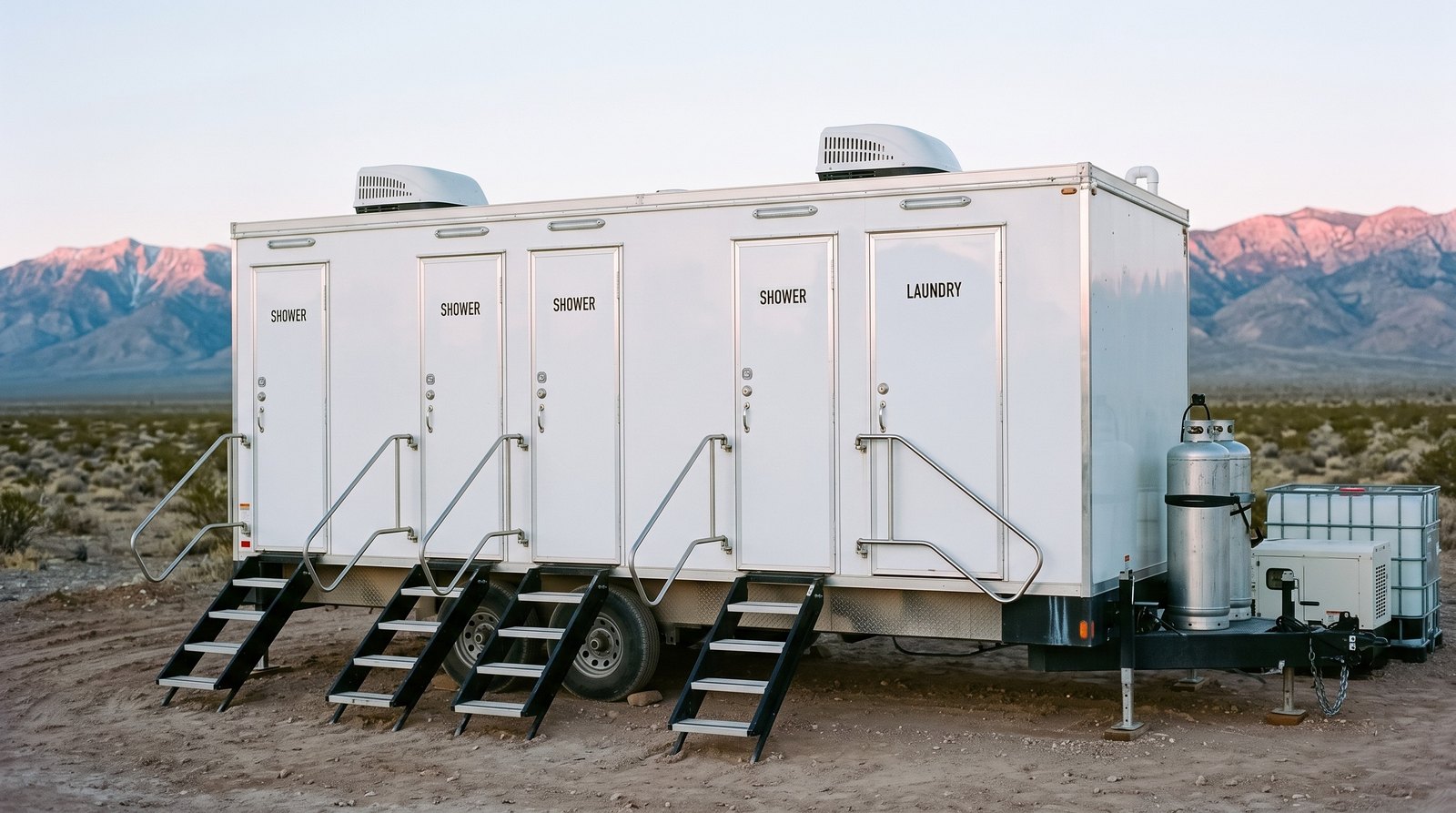
Off grid
Onboard fresh and waste tanks plus generator power for pads past the last hookup.
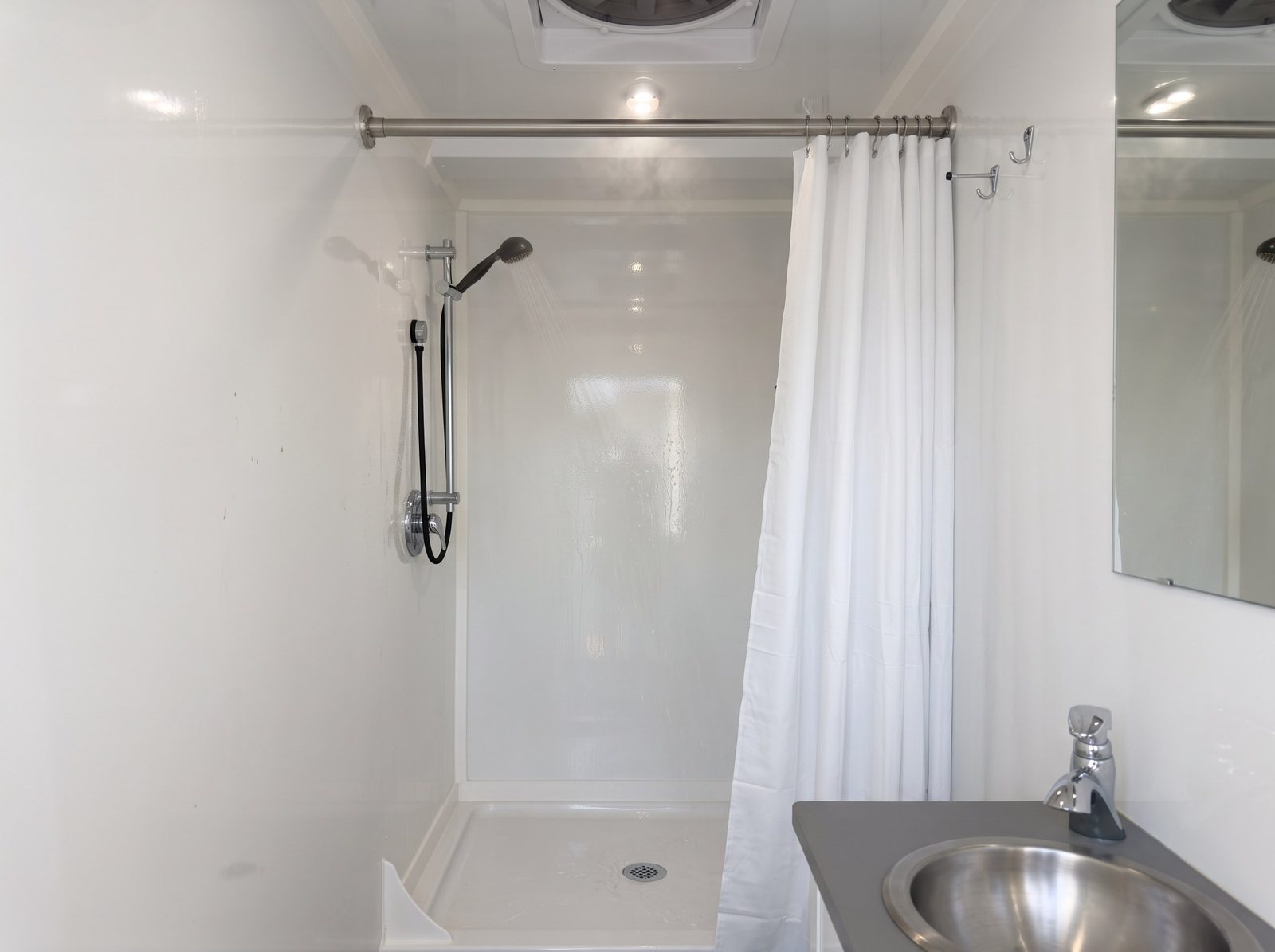
Interior
Latching door, dry changing area, vanity lighting and ventilation that clears steam between users.
Rated by the crews using them
★★★★★Our locker room showers were torn out for five weeks. The four stall unit covered the early morning rush and the water stayed hot the whole time.
★★★★★Out past Boulder City there is no water and no power. Tanks, generator and air conditioning ran for a full rotation without us touching a thing.
★★★★★We needed an accessible shower while our building was replumbed. The ramp, grab bars and roll in stall worked for our residents from the first day.
Inside the door
Every shower has a door that latches from the inside. Nobody stands in a common room in a towel waiting for a head to open up, which sounds like a comfort detail and is actually a throughput detail: people move faster through a unit they are not self conscious in, and a crew that would rather drive home dirty than use a communal setup is a crew the rental did nothing for.
Behind that same door is a dry changing area, separated from the spray, so a towel and a set of clean clothes are not soaked before anybody gets to them. On a dusty job that dry side is where the work clothes come off, and keeping the two zones apart is most of what makes the unit usable at the end of a shift rather than just present.
The interiors are finished. Walls, floors and fixtures are built to be cleaned rather than wiped around, and the vanity side has mirrors, counter space and lighting bright enough to shave by before a morning safety meeting. Ventilation pulls steam out while the stalls cycle, so the fifth person in is not walking into the fog the first four left behind. Interior and step lighting means the unit is usable at night without the site rigging a work light at the door, though general site lighting and security around it stay the client's to arrange.
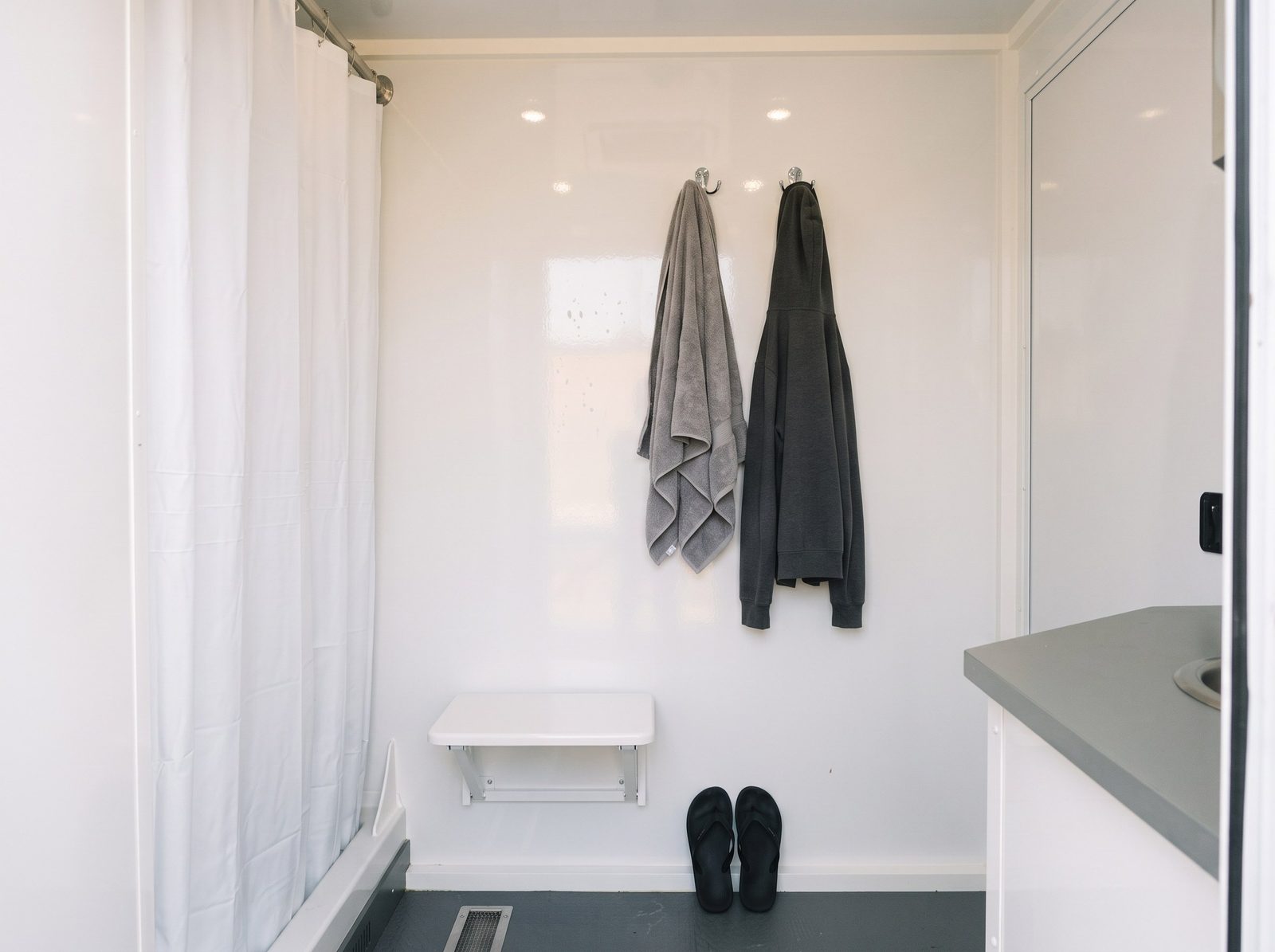
Hot water
Hot water is produced on demand as it moves through the heater rather than drawn down from a reservoir that runs dry and leaves the back of the line under cold water. But that distinction only matters at one moment. It is the moment the whole rental is judged on: shift change, when the entire crew hits the trailer inside the same half hour and the stalls run back to back with no recovery time.
The practical numbers behind it are worth knowing when you are planning. A shower head moves somewhere between two and six gallons a minute depending on the fixture, so a single shower lands roughly in the ten to thirty gallon range depending on how long people take. Multiply that by the number of people who will genuinely use it. You now have the daily draw. It decides tank size and refill schedule far more than the stall count does. Forty people showering once a day sits somewhere around four hundred to twelve hundred gallons, and those two ends of the range are a completely different service plan.
The heating itself is propane fired, which matters for a reason that surprises people: it barely touches the electrical budget. A propane unit draws only a few amps for ignition and controls. The electrical load on these trailers comes from the air conditioning and the pumps. Not the hot water. So a site that assumes hot water is the power hog ends up sizing the generator around the wrong thing.
Fresh water
Every trailer carries its own fresh water tank, and that tank is what makes the unit independent. Where a site has a working hose bib with decent pressure inside hose reach, we connect to it and the tank simply buffers demand. Established commercial, municipal and residential locations usually have one, and it is the simplest arrangement there is.
Where there is no bib, and on raw parcels and remote ground there usually is not, fresh water gets trucked in and the tank refilled on an interval set against the actual expected headcount. This is the normal configuration on newly graded industrial land, mining and solar sites and most desert event locations, not an unusual one.
Refill interval is arithmetic, not a guess. Daily draw comes from headcount and shower length. Tank capacity comes from the unit. Divide one into the other, take a margin off for the days somebody stays under the water longer than planned, and that is the schedule. Where we need a real answer from you is headcount, and specifically the number of people who will actually shower rather than the number of badges on the site. A crew of sixty where twenty five shower on site is a very different plan from a crew of sixty where all sixty do.
The other thing that changes it is whether the number moves. Crews ramp up through a build phase, and an event's vendor and production headcount climbs for days before the public shows up. If a job doubles in week three, we would rather set a bigger unit or a tighter interval at booking than fix it on a Friday afternoon.
Waste
Everything the trailer produces is captured. The shower side and the toilet side both go into sealed onboard holding tanks, and both come out the same way: a licensed pump out to an approved disposal or treatment point. Nothing is released to open ground, into a wash or toward any waterway, on any job, no matter how remote the site is or how much easier it would be. A rental company that treats that as flexible is a liability on your site rather than a vendor.
A useful planning benchmark for pump out frequency is roughly seventy five to a hundred total uses for every hundred gallons of waste capacity. It is rough on purpose, because how heavily people use the stalls shifts it, but it is close enough to build a schedule on. Servicing tracks headcount almost exactly. A two hundred person crew needs the same unit emptied about four times as often as a fifty person crew does. Larger crews therefore need either more capacity, more frequent visits, or both, and that is a decision to make at booking rather than discover mid rotation.
On multi day events, servicing gets scheduled into the run rather than held until the gauge says full. Usage is concentrated and the window to get a truck in and out is narrow, so it goes on the plan alongside everything else. On remote sites the interval is set by the drive to the nearest approved disposal point, which can be a long haul from a mining adjacent site or a desert support zone, and that drive is a real constraint rather than a detail.
One more access question that gets missed: whether the pump truck can reach the unit where it sits. And that is not the same question as whether the delivery truck could. A trailer tucked into a tight dock area or backed against a fence may be perfectly placed for the crew and impossible to service without moving it.
Power
Tied into standard service, a larger multi stall unit commonly wants a dedicated circuit in the thirty to fifty amp range. If the site can offer that and it is genuinely available rather than already carrying half the trailer park of equipment on the job, we use it and the generator stays out of the picture. Overnight crews notice the difference, because a generator is noise that runs all night next to wherever people are trying to sleep.
Where there is no service, a generator has to carry the full simultaneous load: lighting, the water pump, controls, and above all the air conditioning, which dominates everything else in a southern summer. Sizing off a nameplate rating taken on a mild day is the single most common way a unit lets a crew down in July. We size for continuous duty in the ambient heat the trailer will actually sit in.
Fuel gets its own schedule. A tank that carries a unit through a stretch of light use might run six to eight hours, and far less than that with air conditioning working flat out through an afternoon. On a remote southern placement, fuel resupply is part of the service plan rather than something the site remembers on day two. Whether the generator comes with the rental or the site supplies its own is settled at booking, and either arrangement works as long as the rated output actually matches the load.
Climate control
The interiors are climate controlled in both directions, because the state asks for both, often in the same month at different ends of it.
In the southern valleys, air conditioning is not a comfort feature, it is the reason the unit works at all. A trailer on an open pad through a summer where afternoons sit above a hundred degrees for weeks, and push past a hundred and ten more than once, is fighting the air the entire time. The compressor and the generator both get specified for continuous duty at that ambient temperature. Placement helps. Shade if the site has any. If not, an orientation that puts the trailer's own body between the afternoon sun and the door side, which sounds minor and is worth several degrees inside.
North of the middle of the state and at higher elevation, the problem inverts from roughly November into March. A unit staying out through the cold months gets fresh and waste lines heat taped and insulated, thermostat controlled heater pads on the tanks that come on as the contents approach freezing, and a skirted or enclosed underbelly with a heat source behind it. Skirting alone lifts the temperature under a trailer by ten or twenty degrees, which is genuinely useful and genuinely not enough once the air stays below freezing for nights in a row. The generator then has to carry that heating load on top of everything else, so a winter unit in the north is not sized the way the same unit is in June.
Dust is the third climate factor and the one nobody budgets for. Fine desert grit, especially during the storm season in late summer, works into intake vents, condenser fins and any exposed mechanical surface. Units working southern ground through those months get filter and vent checks more often than a unit sitting on clean pavement, and that is built into the service visit rather than added as an extra.
Accessible units
An accessible unit has three rooms: two standard private rooms plus one accessible room, the wheelchair usable one. It is built to the dimensions in the 2010 ADA Standards for Accessible Design rather than to a loose reading of them. In practice that means a ramp with a slope no steeper than one inch of rise for every twelve inches of run, a non slip ramp surface with sturdy handrails, an entry door with a clear width of at least thirty two inches and often thirty six for more generous clearance, and interior clear floor space allowing a full sixty inch turning circle for a chair.
Inside the shower itself: a low threshold or roll in pan so a chair can enter without a lip to climb, grab bars, controls within reach, and a handheld sprayer on a flexible hose of at least fifty nine inches with an adjustable vertical slide bar. Those are common accessible design standards. They are not a quoted code section, since how portable and temporary structures are treated varies by jurisdiction and use. If a specific code citation is required for your project, confirm it with the authority reviewing your site.
The detail that catches people out is footprint. Ramp length is a direct function of how high the trailer floor sits above the ground, because the slope rule fixes the ratio. A taller entry threshold needs a longer ramp to match, and that ramp has to land somewhere. At one inch of rise per foot, a floor thirty inches off the ground needs thirty feet of ramp before the landings. Behind a resort loading dock downtown, that run can decide whether the unit fits at all, so it belongs in the site layout before delivery rather than being discovered on the day.
Accessible layouts get committed further ahead than standard ones, so bring it up on the first call rather than the last. Availability for your specific dates is the honest limit, and you will hear the real answer.
Sizing
The rough number we start from is one stall for every eight to ten people when showers spread across a shift change. If everybody arrives at once, because the gate closes at a set time or the crew comes off the hill together, plan on more doors than that ratio suggests. The busiest twenty minutes of the day decides the unit, not the total on the time sheet.
Shift pattern matters as much as headcount. A site running two shifts spreads demand across the day and can often do more with fewer doors than a single shift site with the same number of people. A rotation where crews come off a multi week hitch all at once behaves like an event rather than a construction job, with a spike instead of a rhythm.
And then there is the difference between a construction placement and an event placement. The sizing logic runs opposite ways. A construction rental is a longer placement, weeks to months, on one pad, with a stable crew and a service cadence matched to it. An event rental is short, a day to a week, but with concentrated usage that can exceed a construction site's entire week inside two afternoons, which means servicing during the run rather than around it.
If you ask us for more stalls than the job calls for, we will say so. A unit that sits half used is money spent on nothing, and the smaller unit with a sensible staggered schedule is frequently the better answer. Occasionally it goes the other way and the honest answer is that the job needs more than you were planning for.
Every layout, one table
The same five questions decide every order, so here they are in one place for each layout we send out. The crew sizes assume showers spread across a shift change at roughly one stall for every eight to ten people. If everyone arrives at once, move down a row.
| Layout | Doors | Crew it suits | Water and waste | Power | Where it usually goes |
|---|---|---|---|---|---|
| Four stall shower trailer | Four private stalls | About 30 to 40 people | Onboard fresh and waste tanks, or a hose bib where one exists | Site circuit or a generator | Back of house resort work, small crews, short events |
| Eight stall private shower trailer | Eight private stalls | About 65 to 80 people | Larger tanks, so fewer visits for each person using it | Upper end of the 30 to 50 amp range, or a generator sized for the air conditioning | Data center builds, festival staff, plant shutdown crews |
| Shower, restroom and laundry combo | Shower stalls plus restroom rooms, laundry or both | Camps where people live on site | Waste fills sooner for the same headcount, and laundry adds its own water draw | Site circuit or generator, sized with the laundry load | Mining camps, long rotations, multi day events |
| ADA ready shower unit | Two standard private rooms plus one accessible room | Any site that needs an accessible stall | Same tanks as a standard unit | Same as a standard unit | Needs level ground and room for the full ramp run |
| Off grid setup | Any layout above | Any crew past the last hookup | Hauled fresh water and scheduled pump outs | A generator carries the whole load | Solar fields, exploration camps, dry lake race support |
Two jobs with the same headcount can land in different rows. Forty people on one shift who all walk off at 3:30 need the eight stall unit, while forty spread across two shifts are comfortable on four stalls. On long placements the pump out math changes the answer again. A four stall unit that needs a visit every other day on a pad past Beatty can cost more in drive time than an eight stall unit serviced twice a week. When the numbers are close, we lay out both and tell you which one the schedule favors.
Ground with nothing on it
The self contained configuration is what most of the harder Nevada work needs: onboard fresh and waste tanks, generator power, hot water on demand and climate control running the whole time, on ground that offers nothing. Mining camps already run this way. Their crews live near the drill pads on multi week hitches in country with no water and no power for a long way in any direction. Utility scale solar construction in the southern desert has the same profile, with a large temporary workforce through a build phase of a year or more before the site drops to a skeleton operating crew.
The ground itself is the constraint people underestimate. The trailer needs a stable, load bearing, reasonably level surface. Compacted gravel, asphalt and concrete all work. Soft sand, loose fill and an unconfirmed slope do not, and a trailer that is not level strains plumbing fixtures, door alignment and the leveling jacks themselves. Leveling blocks and jacks handle minor grade. A genuine slope gets fixed before delivery rather than argued with on the day.
On desert ground, drainage belongs in the placement decision too. The same summer storms that raise the dust drop rain hard enough to flood a wash or a low lying pad that was bone dry that morning, so a spot is chosen for where the water goes as well as for how flat it is. We wrote the long version up in choosing and preparing a shower trailer site in Nevada.
Combo layouts
A shower only unit is the right answer on a job where people go home at night. It stops being the right answer the moment the site becomes where people live, and that happens more often in this state than most people expect: exploration camps on multi week hitches, solar and industrial builds an hour from the nearest town, production units parked somewhere scenic and empty, and response operations that stand up a base camp and keep it running for weeks.
Combo layouts pair shower rooms with restroom rooms, laundry, or both. Restroom rooms in the same trailer matter when a site is meeting its sanitation obligation and its hygiene need with one delivery instead of two, and when the walk between the two would otherwise cross an active work area. Laundry matters on long rotations. A crew with clean bodies and dirty clothes has solved half the problem. And on a dusty site the clothes are the half that keeps everyone uncomfortable.
What a combo changes on the ground is the service math. More fixtures in one trailer means the waste side fills sooner for the same headcount, and laundry pulls fresh water at a rate that has nothing to do with how many people showered. Both push the service interval tighter than a shower only unit on the same job, so the schedule is built off the whole unit rather than the stall count.
The other configuration question is whether one larger trailer or two smaller ones suits the site better. One unit is a simpler delivery and one service stop. Two units placed at opposite ends of a long site can cut the walk in half, which on a linear job or a large festival ground is the difference between a facility people use and a facility people mean to use.
Once it is set
Repositioning is possible and it is not a casual same day adjustment. A trailer that moves has to be disconnected, drained or serviced as appropriate, towed, releveled and reconnected at the new spot exactly as it was at the first one, with water, power and waste all resolved again. That is a scheduled visit, not a favor somebody does on the way past.
It comes up most on linear work. Highway and utility projects move along a corridor in phases rather than sitting on one property, and the crew's location shifts with them, sometimes several times over the life of the job. The same thing happens on large sites where a building goes vertical where the trailer used to sit. In both cases, the move goes on the plan at booking when it is foreseeable, and gets scheduled with a few days of notice when it is not.
What makes a move quick is the new spot being ready before the truck arrives: level, load bearing, reachable, and with the same access questions already answered. What makes it slow is arriving to find the new pad is the old pad's problem all over again.
The work these end up on
The calls come from all over the state and the reasons repeat. Crews with nowhere to wash, events with more people than plumbing, buildings that lost hot water for a week. Our planning guide for construction and mining crews goes deeper on the rotation side of it.
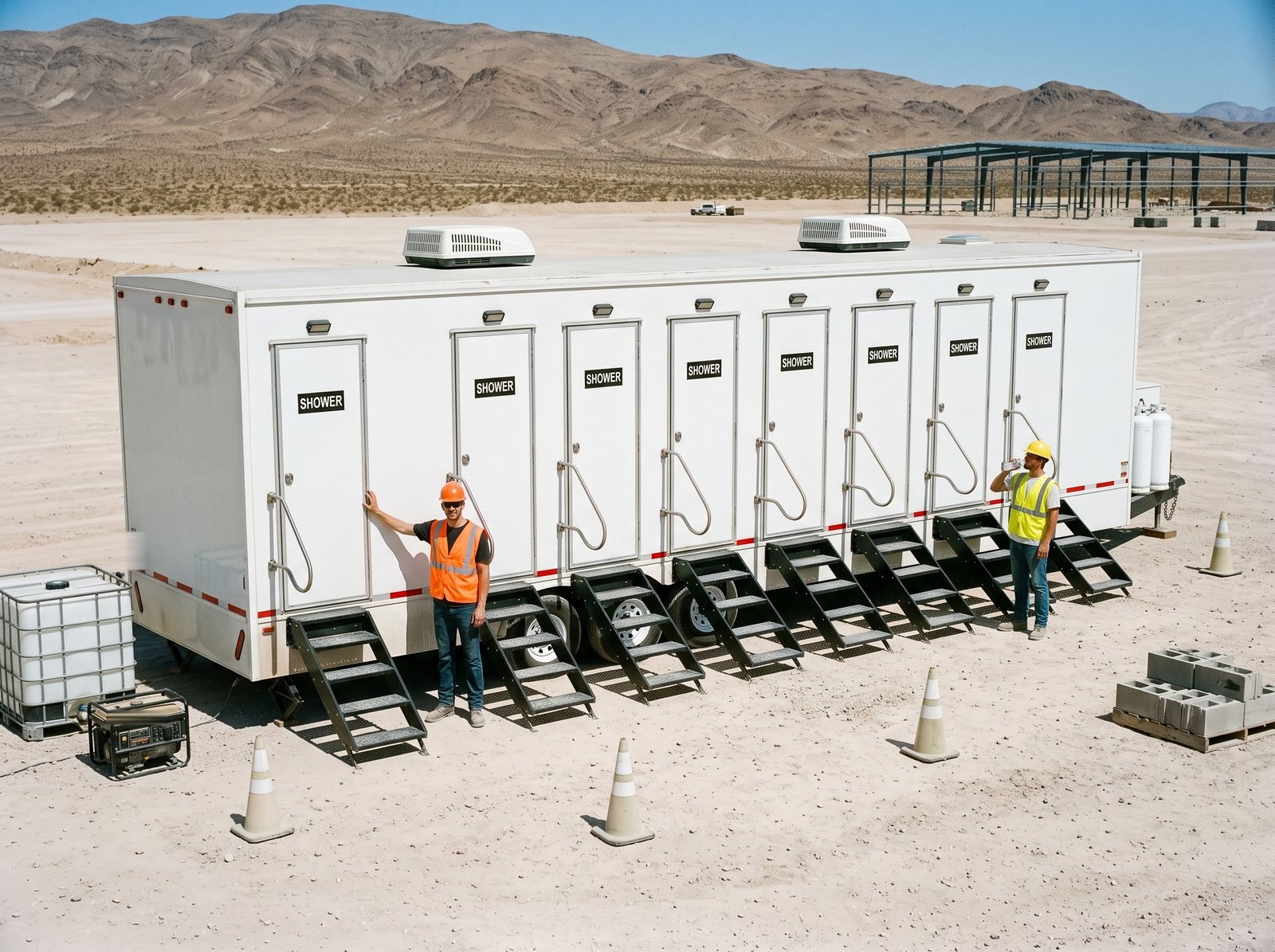
Data center and distribution builds on newly graded land, tilt up concrete and racking work on a compressed schedule, and crews on site twelve hours a day in heat that makes a quick wash a safety measure rather than a courtesy.
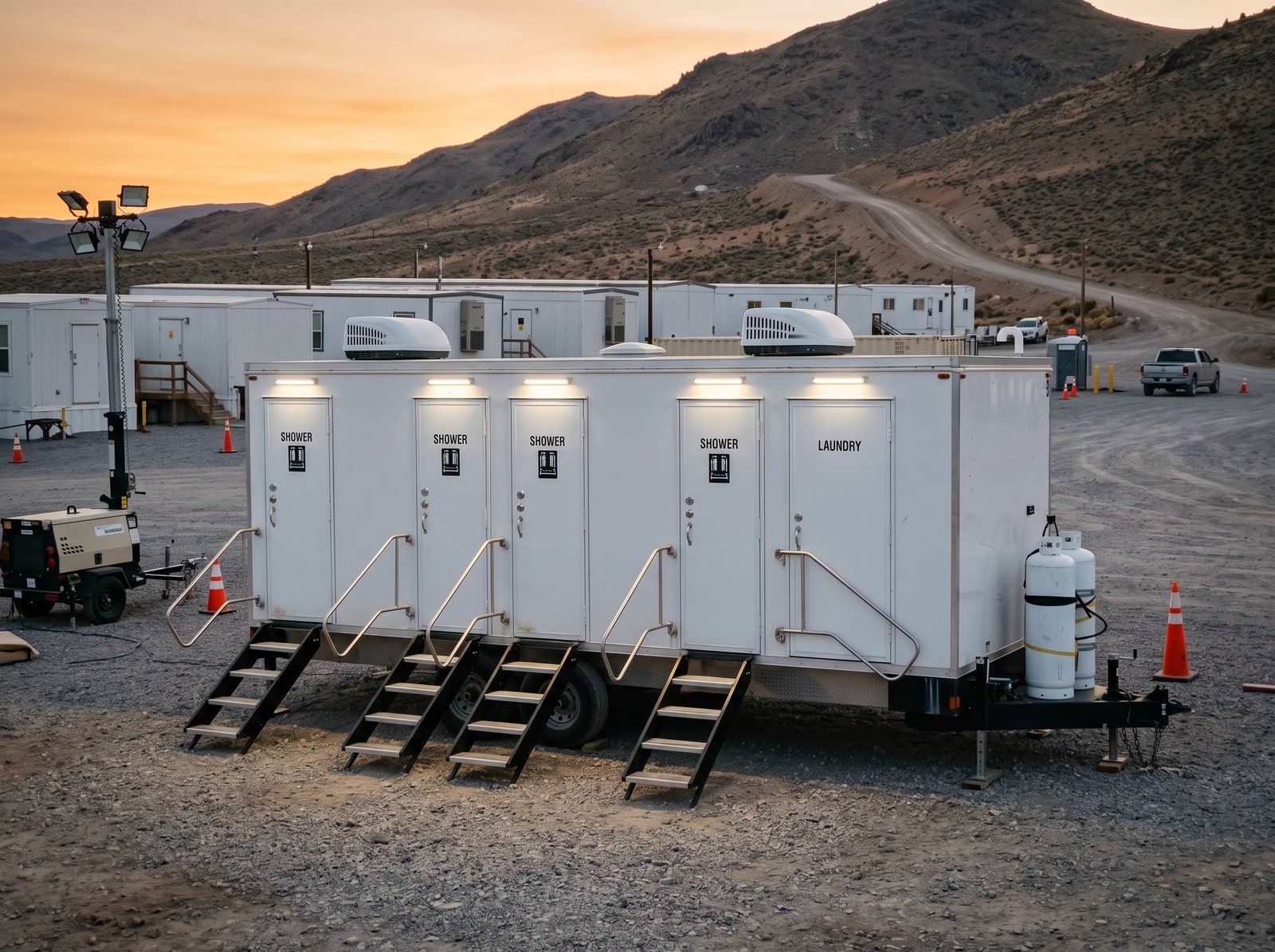
Exploration and drill camps on multi week hitches where the nearest town is a long drive and the whole hygiene setup arrives on a trailer or does not exist.
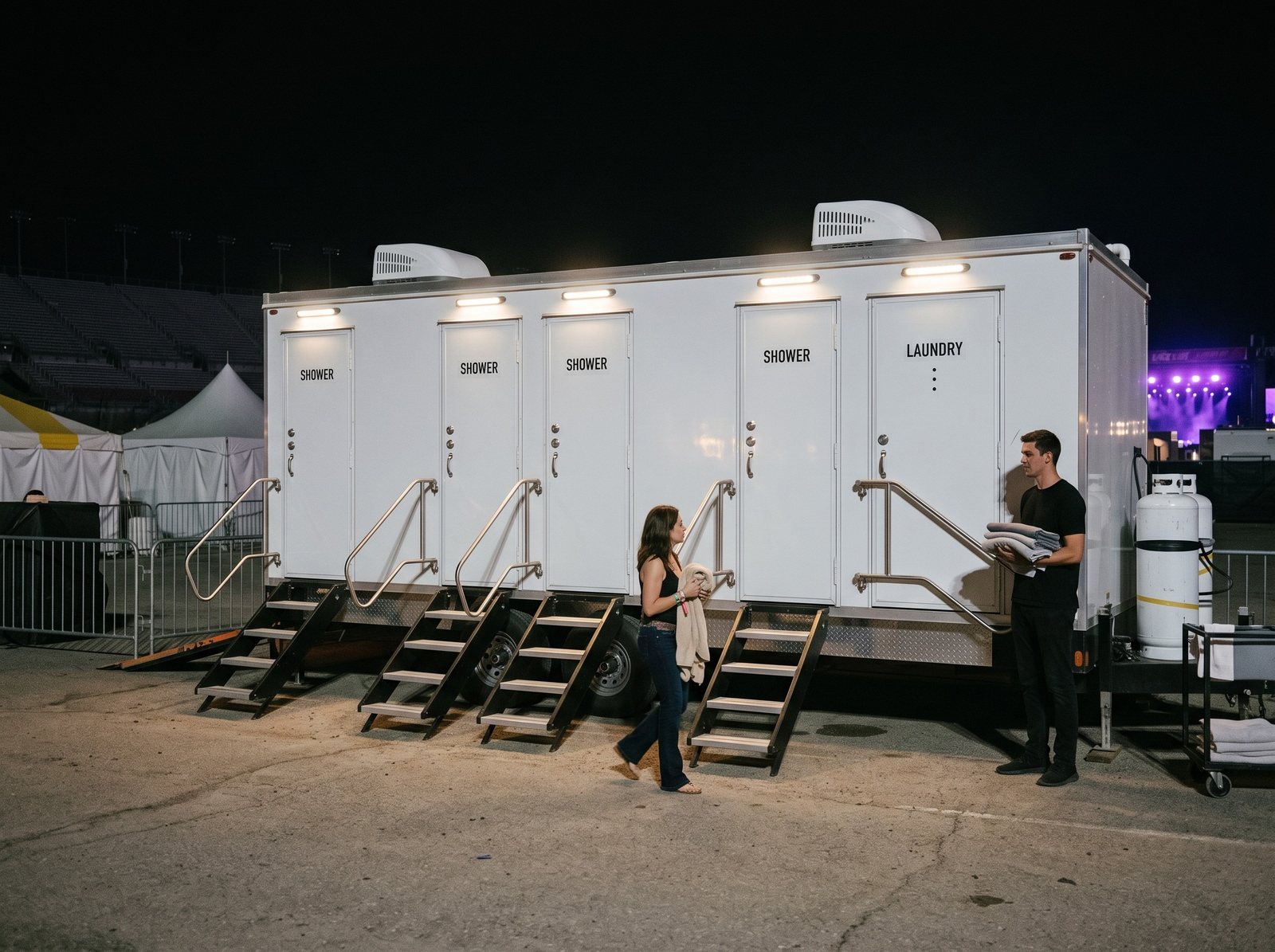
Production staff, vendors and racers on the ground for days. Dust and heat decide whether a crew lasts the weekend, and the people who need the showers most are usually working, not attending.
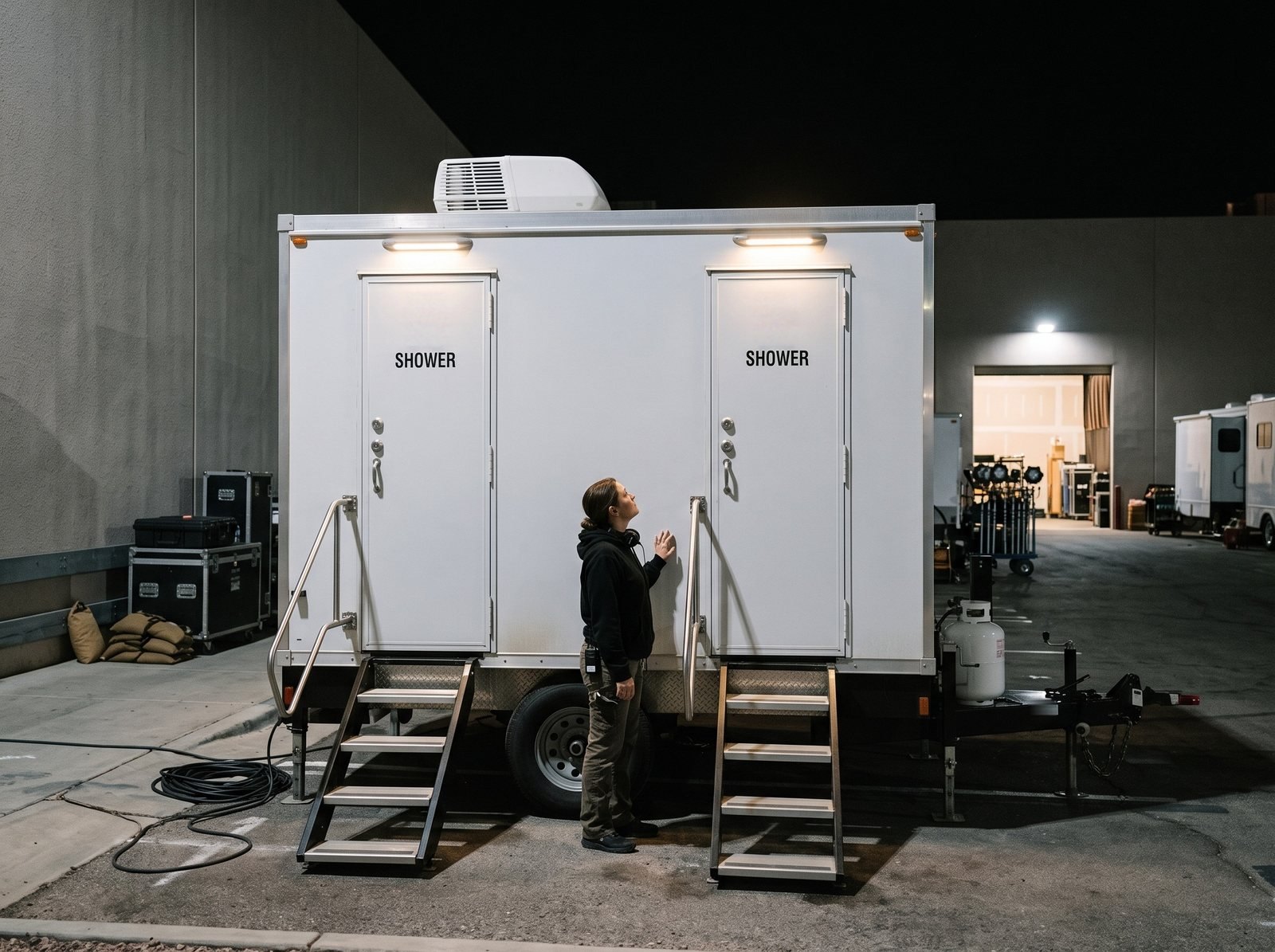
Cast and crew parked on open ground or in a lot, long days, a call time that does not move, and a unit that has to look right sitting next to the rest of the camp.
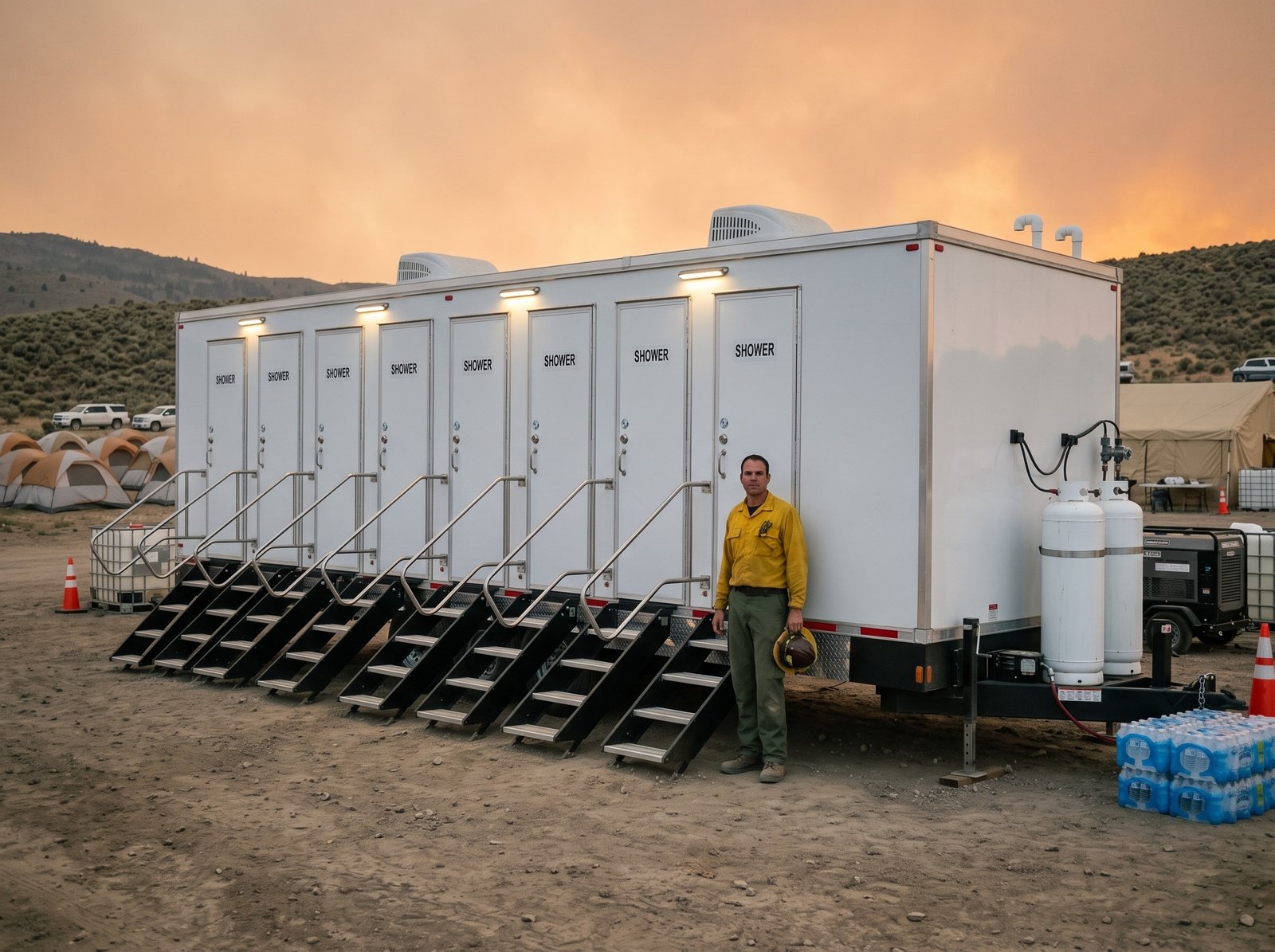
Response operations run on a full camp: water, sanitation, showers and laundry supporting crews working extended shifts in smoke and heat for days or weeks at a stretch.
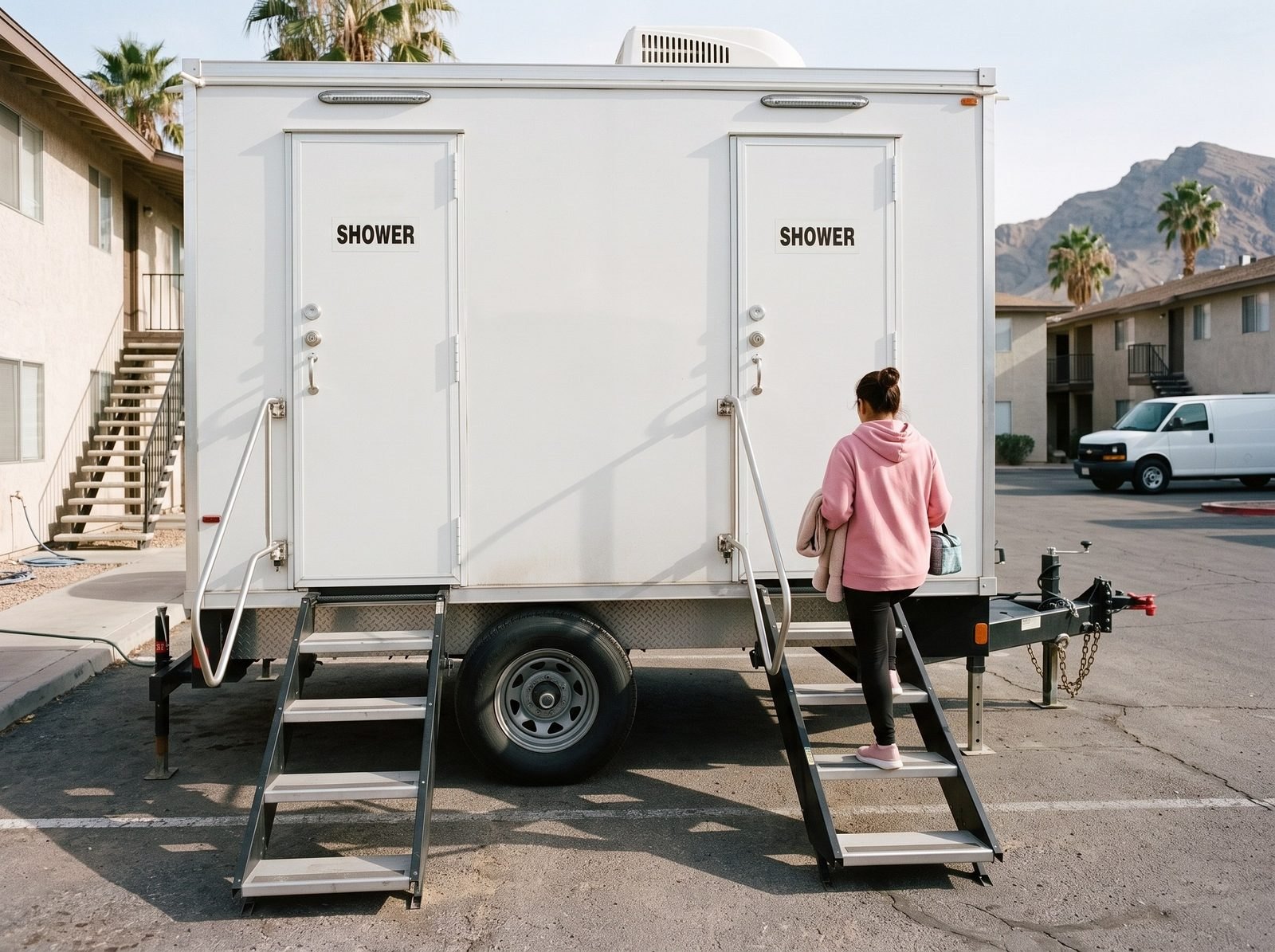
A boiler replacement or a renovation that takes the showers out of a dorm, a shelter, a gym or a care facility, where the building still has to keep people clean while the work runs.
The rental itself
Delivery is ours. We bring the trailer, place it where you want it, level it, make the connections, and run every stall before the driver pulls off: hot water, drains, lights, latches and vents. We would rather find a problem with a wrench in hand than hear about it at six the next morning from somebody who could not get a hot shower.
On longer runs we come back on the agreed schedule to pump the waste, refill fresh water, restock consumables and clean the interior properly. In the dusty months that visit includes the vents and condenser. At the end we collect the unit and leave the pad as we found it. Extending is normal and usually easy if your schedule moved, which it will.
One thing worth saying plainly about job site rules: the federal sanitation standard for construction work, 29 CFR 1926.51, requires toilets and genuine handwashing with soap and running water, scaled to crew size, and it treats a facility that takes more than about ten minutes to reach as not actually available. Showers are not mandated by that standard in most cases. Contractors provide them anyway, for heat relief in the south and for retention everywhere, and increasingly because a crew that can clean up on site is a crew that comes back. Heat stress is a recognized workplace hazard, and the NIOSH guidance on heat stress and workers puts the job of reducing it on the employer.
When you call, the conversation moves faster with these in front of you.
With those answers we can usually name the right unit on the first call. Send them through the quote form or call (702) 960-1918, seven days a week. Where we haul and what the drive looks like is on where we deliver.
Headcount, dates and the ground it sits on are enough for us to name the trailer that fits and the schedule behind it.